• Why React Js Development Services Are Essential For Modern Web Applications?

    Why React Js Development Services Are Essential For Modern Web Applications?

    In the modern day, many organizations are looking to create the most scalable and responsive web apps. These are significant options for managing more traffic along with better user interactions. Based on a recent survey, about 53% of mobile users have quit the app that takes more than 3 seconds to access.

    Are you looking to create a web application for your business? Considering React.js is an excellent choice for software projects. Choosing to hire dedicated react js developers remotely is a significant option for getting quick React Js Development Services for developing high performing apps.

    What Is React Js?

    In 2013, Facebook launched React, and this has grown into a higher popularity. React.js has become a widely used framework to develop modern web apps. React.js is normally an extremely powerful JavaScript tool which is useful for creating user interfaces. These are declarative and completely component-based for beginners to easily comprehend. 

    React Js is completely simple to develop and these become a reason for the success. These also extensively allow the construction of reusable elements, which can be used even on multiple spots. React.js is involved with the larger community, and many developers are quite accessible.

    Reason To Use React JS Development Services For Modern Web Applications

    React.js is quite an amazing option for developing web apps. These are the common picks for developers due to their robust features along with flexible designs. The key function of React.js is listed below for developing online apps.

    • Component-Based Architecture

    React.js allows developers to easily create the most amazing Component-based design. These significantly split the user interface across varied independent aspects. Creating the fully operational components is more efficient with this approach. They also reduce the complexity of development and testing, resulting in a flexible manner.

    • Virtual DOM

    React.js employs the virtual Document Object Model (DOM), which also updates as well as displays the components. It is also one of the unique strategies for reducing time along with resources essential for updating the real DOM. The process also results in increasing performance levels along with quick rendering.

    • Data Binding

    React.js employs an amazing one-way data binding strategy. These involve data traveling in single directions. It is an amazing approach for comprehending and debugging unique data accessibility. 

    Data binding is one of the reasons for choosing React Js Development Services for web applications. These massively improve sustainability and give a consistent user experience.

    • Well-Organized Workflow

    React JS framework involves amazing ecosystems for modern web applications. These are the most cutting-edge development tools for supporting varied widgets. It also involved more ongoing community support. 

    React Js allows the developers to use various tools such as React DevTools, React Router, and Redux for state management. It is best to hire dedicated react programmers from BOSC tech labs to improve the development workflow. These massively increase productivity to the highest levels.

    Read About Best Practices for React Application Architecture: Tips for Developers

    • Improved User Experience

    ReactJS development services are significant for creating a unique user interface. These are completely engaging and interactive for improving better user experience. The framework also increases customer engagement and conversions. 

    Numerous user interface components are available for creating dynamic and responsive attributes. These can be easily integrated with the web applications for gaining a consistent user experience.

    • SEO-Friendly Solution

    React.js offers the server-side rendering (SSR) along with static site creation Compared to JavaScript frameworks. These also help with creating the SEO friendly web apps. Normally, the search engine can quickly crawl and index information with SSR. These efficiently increase SEO effectiveness and enhance search engine visibility.

    • Community Support

    ReactJs framework helps the developers to save more time. React Js have excellent documentation, enthusiast community, materials, lessons and more. It is also a significant option for achieving the regular updates for resolving any problems. 

    React.js is especially the future-proof solution for software development services. Many numbers of large corporations have been frequently using them for various purposes.

    • Reusable Components

    ReactJs developers have the ability for creating the best reusable components. These involved component-based architecture along the individual components. 

    It also represents the specific piece of user interface like button, form, navigation menu and more. These reusable components are defined with JavaScript. These include the component’s behavior along with a visual appearance on extensively saving time.

    • Popular Libraries

    Normally, Flux and Redux are some of the most amazing libraries which have been useful for building web apps. Flux consists of the 3 main components such as the dispatcher, view and Store. 

    The Redux is the most important library, which is inspired by the Flux for gaining the unidirectional data flow. Redux simplifies all the Flux architecture by easily combining the Dispatcher and Store.

    • Use Of React Hooks

    React hook is the most important feature of the React.js, suitable for implementation with JavaScript functions. It is one of the best features, allowing developers to use the React features.

    Conclusion

    React JS has the most amazing ecosystem with many third-party libraries, tools, as well as frameworks. The ReactJS ecosystem is highly preferred by many developers for creating Modern Web Applications. 

    React JS has become the most essential for modern web development because of the component-based architecture, reusability, and more. These empower developers to develop highly interactive and scalable user interfaces.

  • Why React Developers Are Crucial For Modern Web Development?

    Why React Developers Are Crucial For Modern Web Development?


    In the ever-evolving digital landscape of website development, it is most important to choose the right technology stack. In the modern day, there are a myriad of options available for web development. 

    React.js emerged as one of the cornerstones by simply redefining web application developments. Many companies also choose to hire dedicated React developers for building scalable web development projects. ReactJS Developers play a major role in designing and developing the website based on the platform.

    What Is React Js?

    In the modern day, React becomes one of the most amazingly used frameworks for easily building web applications. Based on recent statistics, there are 42.62 % of respondents reported using this platform. React is normally the JavaScript library which has been developed by Facebook. These have been used for building the famous Instagram.com. 

    React.js allows developers to create fast user interfaces for websites and applications. The main concept involved in React.js is virtual DOM. These are completely tree-based on JavaScript components. These have been created with React, which mimics the DOM tree.

    • Component-Based Architecture

    React.js becomes one of the popular and widely adopted JavaScript libraries to easily construct user interfaces. These are the modern web developments which arise from varied key factors. This platform has become one of the most amazing options for developers. 

    React.js involves the complete component-based architecture. So, these allow the ReactJS developers to break down user interfaces to make them into modular components. Component-based development gives you more benefits that include code reusability, maintainability, and scalability.

    • Virtual DOM And Performance

    Virtual DOM is an in-memory representation of the real DOM, and these are much more helpful for easily enhancing the performance of web applications. These directly manipulate real DOM by changing the features. 

    Virtual DOMs are more useful for increasing the speed of web apps while minimizing unnecessary re-rendering of components. These also efficiently update the necessary parts of the UI. Vetted ReactJS developers are quite well-versed in dealing with the Virtual DOM.

    • Knowledge Of React With Firebase

    Dedicated ReactJS developers also have more knowledge in integrating React.js with Firebase. These are suitable for easily creating the most beautiful customized applications.

    • Expertise In React With Django

    React JS developers have more skills and knowledge in easily integrating React.js with Django. It is one of the reasons why React Developers are quite crucial for Modern Web Development. Integrating React with Django lets us extensively create robust and user-friendly web applications based on the requirements.

    • Reactjs UI Development Made Easier

    Normally, the interactive knowledge of React frameworks lets proficient ReactJS developers easily create the perfect UI Development. The developers also utilize multiple components for creating the most engaging and intuitive UI designs.

    • APP Migration To React

    Vetted ReactJS developers are also well-versed in dealing with ReactJS migrations. These are significant options for updating existing web applications securely. There are many methods involved in making the ReactJS migrations using this ultimate platform.

    • React Native Solution

    Skilled and well-experienced ReactJS developers especially follow the agile approach for developing mobile apps. It will be suitable for developing the apps for both the Android and iOS operating systems. 

    React Native lets the developers reuse the maximum code, saving more time in the process. It lets the developers improve the design level to the maximum. 

    • Declarative Syntax

    ReactJS especially has a declarative nature, so this simplifies the UI development. These allow the developers to easily describe the way the UI looks. It is a more efficient option for changing the design of web developments. 

    Contrast declarative programming is a suitable option for saving more time. This imperative programming would highlight the massive advantages of declarative syntax with maintainability and code readability. The declarative syntax has been used for various mobile app developments for saving more time in the process. 

    Know Future of ReactJS and How it fits into the JavaScript Ecosystem

    • Reactjs With Express

    Dedicated ReactJS developers are well-versed in integrating React.js with Express. These are significant options for creating interactive, user-friendly and best-quality applications. It is quite an efficient option to build full-stack applications consisting of the frontend framework, such as React.

    The backend framework such as ExpressJs has been widely used for various application developments in the modern day. React contributes an interactive user interface, and Express handles data storage, server-side logic as well and API endpoints.

    • Creating SEO Friendly Applications

    Search Engine Optimization plays the most important part in web applications for enhancing the ranking in the search results. The React involves the server-side rendering capabilities. 

    These enable the search engine to easily crawl along with index content. Developers are well versed in creating an SEO-friendly nature for ReactJS-powered websites, ensuring they are highly visible in all aspects.

    • Enhanced Developer Experience

    React.js especially promotes the most delightful developer experience. These also have intuitive syntax with robust developer tools. It facilitates excellent debugging and code analysis. 

    It involves a strong type-checking system like TypeScript, so they give you the absolute solution. These also enhance the code reliability, making React.js one of the significant options for developers.

    • Simple-To-Grasp Dev Workflow

    The major reason to use React.js for web development is the optimized development interface. These are completely lightweight for creating React’s API and allow faster performance-level capabilities. They are significant options for achieving rapid and hassle-free developments. React components are quite simple, and they do not have a learning curve.

    • Hassle-Free Reusability Of Components

    React.js is used for web development as they are significant to have separate components. Created components are easily reused and it is the major reason for the developers to use this platform. 

    React.js web application element can be used anytime for getting the unique results. It is also a significant option for adding more project compatibility to the React-based code.

    Conclusion

    In the fast-paced digital era, React.js has become more than just a library for web development. The platform has the ability to enhance efficiency and create dynamic user interfaces. So, hire React developers team from BOSC Tech Labs for modern web development to get prominent results.

  • How React Developer Help to Your Project Into Next Level?

    How React Developer Help to Your Project Into Next Level?

    In the modern era, business is seeking the best way to stand out from the crowd. React is a practical open-source JavaScript library to create the web application. It is the most excellent front-end development technology that provides endless benefits for developers and businesses. If you need to develop robust software, you can hire an experienced hire react developer for your project. 

    Numerous React developers are available in the market because of React’s popularity. It is vital to choose the best React developer for your project. They understand your requirements and put more effort into completing your project smoothly. When you join hands with a professional React developer, you can stay in peace of mind and build interactive user interfaces.  

    Over two lakh websites are using React due to its versatility. React supports numerous technologies and modern designs that make it simple to develop quality applications. Even the leading companies have hired the React developer for their software solution. Keep reading the post to explore reasons for hiring React developers for your project:

    The role and responsibilities of a React developer

    The role of the React developer is to create user-friendly features for web applications. They know the state, lifecycle hooks, components, events, and more elements. In addition, the React developer is responsible for the website look to offer a reliable user experience. With the help of JavaScript, they can create the UI, which is trouble-free to maintain. 

    The expert performs the back-end service and has experience creating the front-end interface. They use their knowledge of programming languages such as HTML, JavaScript, CSS, and more. In addition, the developer works with software testing professionals to determine the code before launching the website or app. 

    In addition, the React developer understands the React library and their technologies. They create bug-free and functional websites or applications with outstanding performance. The expert knows what design and interface React provides. They develop new plug-ins that update the application. 

    Why hire a React developer for your project? 

    Here are some reasons for hiring a professional react developer for your project that every business owner should know:

    • Implementation 

    Compared to other libraries, such as Node.js, React is simple to implement. For this reason, React developers have gained more popularity. The developer helps the organization create the React app faster. 

    They break down the complicated UIs into reusable components that boost collaboration and facilitate code organization. It offers a robust codebase that is vital for long-term project success. 

    • Develop a responsive user interface 

    It is essential to create a dynamic user interface in the React application. When the user interface is poorly developed, it affects the project’s success. Therefore, you should hire the best React developer for your project. They control reusable parts to streamline the app development procedure that offers maintainable code. 

    With the declarative approach, the developer helps you to create an app with a rich user interface. It enables people to use applications without hassle. Besides, this approach offers an engaging user experience and increases app development. React empowers the development team to describe the better outcome. 

    Which are the Leading Web App Development Trends For 2023?

    • Improved user experience 

    Virtual DOM is a critical feature that increases the web application performance. It helps to lessen the manipulation and boost rendering, which offers a responsive user experience. 

    The React developer attaches the virtual DOM power to reduce the need for actual DOM manipulation. It helps to increase the overall performance of the application. React helps to build a single-page app and remove the need for page reloads that offer a seamless experience for users. 

    • State management

    React developers use advanced tools to manage the application state smoothly, such as Redux, Context API, etc. It allows the developer to build data-driven applications with excellent performance. 

    If you centralize the form of the application, Redux shortens data flow and guarantees a single source of truth. In addition, the developer can handle debug issues, state changes, and implement debugging. As a result, you can get a strong foundation for the project. 

    • Cross-platform compatibility

    React Native is the best tool for developing mobile applications with the same codebase. React developers have the skill to create a consistent user experience around multiple platforms that lessen development cost and time. In addition, cross-platform capability helps accelerate development and offer optimal experience on different devices.

    The developer performs testing to ensure cross-browser compatibility and reduce issues. Cross-platform compatibility helps increase your business’s audience base with minimal resources. 

    • Write user-defined components

    React developers can write user-defined components with an optional syntax extension. Developers will find all subcomponents a pleasant experience when using these elements since they accept HTML documents and create descriptions of them. Discussions around JSX have led to the development of custom components, high-volume applications, and the conversion of HTML mockups into ReactElement trees.

    • SEO-friendly applications 

    SEO is the gateway to achieving the goal for online businesses. React simplifies the development process of SEO-friendly applications. The application reaches the top position in the search engine with the quick page load and fast rendering. 

    Qualified React developers use server-side rendering techniques to ensure search engines can index the content smoothly. It helps to increase the discoverability of the project and get organic traffic.

    • Community support  

    React has an active community of developers who contribute to its development continuously. The developer knows how to find challenges, seek adequate practices, and stay informed about modern developments. 

    In addition, many developers join the community daily to make React a simple front-end structure. The React project is developed on a solid foundation with access to tools and a library.  

    Conclusion 

    React is a robust UI framework for creating projects for small and large businesses. Hiring the React developer is critical to optimize performance and improve user experience. 

    When you hire react developer, you can build a successful React app effortlessly and stay in peace of mind. The expert handles everything in the React website or application development. They offer innovative solutions, which ensure your project stays ahead of the curve.  

  • Why You Should Invest in Custom Mobile App Development?

    Why You Should Invest in Custom Mobile App Development?

    The behavior of your customers is changing every day. They have transformed the way they communicate and interact with businesses and retailers. Consumers are incredibly technologically sophisticated and have significantly modified digital technology! Worldwide internet users reached 5.18 billion in 2023, which indicates that over two-thirds of the world’s population is already on the internet.

    The implementation of digital technology in business still needs to be more consistent. However, technology has significantly impacted the nation’s economy and how millions of companies operate in the app development industry due to the quick growth of digital capacities and the widespread accessibility of high-speed internet.

    The statistics show that app developers have seen a significant growth in revenue from their mobile apps over the past few years, both on the Google Play Store and the Apple App Store. Leading companies stay one step ahead of the competition by creating comprehensive experiences while considering mobile’s distinctive features.

    Who is able? This article will teach you a few significant benefits of custom mobile app development services. Before moving further, let’s define “custom mobile app development.”

    What does “custom mobile app development” mean?

    The term “custom mobile app development” describes the process of developing a mobile app from the ground up to meet the needs of a specific business or organization. The widespread usage of software designed especially for smartphones and tablets by consumers is necessary for companies and industries to embrace digital transformation fully.

    Developing a particular mobile application may benefit a business in several ways. These include improved client interactions, more productive processes, and greater output. Mobile app developers have an excellent opportunity to satisfy the organization’s and its users’ needs by incorporating suggestions from both groups into the finished product.

    Developing a mobile app involves several stages: planning, designing, coding, testing, and user release. During the planning phase, the business and development teams choose the app’s goals, features, and target audience. While the app’s functionality is created and integrated during the development phase, the user interface and other aesthetic elements are produced during the design phase. By submitting the application to the appropriate app stores and assuring it passes all essential testing, deployment makes the program accessible to users.

    Businesses may create an effective tool to help them achieve their goals and stand out in a competitive market by developing a distinctive mobile app with an appropriate development team and project management. Businesses should collaborate with reputable and trustworthy mobile application development companies like BOSC Tech Labs to ensure successful custom mobile application development. Businesses can produce top-notch software that meets their goals, boosts growth, and contributes to success by partnering with a skilled team of developers.

    What are the advantages of investing money in custom mobile app development?

    Now that you know what custom mobile app development is, here are some advantages for your business to consider.

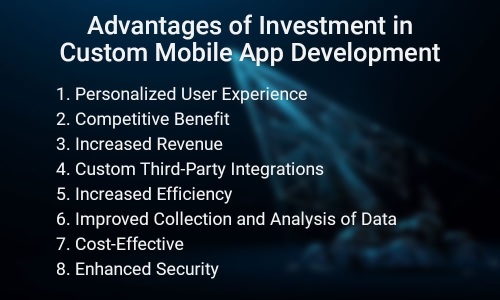
    Advantages of custom mobile app development

    1. Personalized User Experience

    You may improve your users’ overall experience by tailoring your product or service to their unique demands. With custom development, you can be sure that the app is being made with your audience’s needs and preferences in mind, delivering a more specialized outcome.

    Additionally, custom development allows companies to provide functionality that OTS systems might not offer. Businesses can offer more innovative and distinctive offers that ultimately benefit consumers by customizing solutions to user preferences and even addressing them by name.

    2. Competitive Benefit

    In today’s competitive corporate world, staying on top of developments is essential. Businesses may stand out from competitors and provide unique advantages to clients by investing in developing trained mobile apps. A mobile app can be an effective marketing tool that benefits businesses and raises brand awareness.

    3. Increased Revenue

    Over time, custom mobile apps could help organizations establish new revenue streams. Businesses can monetize their app and boost overall income by providing in-app purchases, subscriptions, or other premium features. Giving clients a simple and convenient option to make purchases can also increase sales.

    4. Custom Third-Party Integrations

    A mobile app’s success may depend on its ability to integrate with other apps. While ready-made development offers integration capability, its generic APIs might only be suitable for particular use cases, which could cause compatibility problems and delays. On the other hand, developing a mobile app from scratch can result in APIs explicitly created to meet your demands for integration, facilitating seamless and smooth app transitions. This level of customized features may significantly alter the user experience.

    5. Increased Efficiency

    Improved efficiency is another benefit of a custom mobile app. Businesses can save time and costs by automating particular processes, allowing employees to concentrate on more critical aspects of their work. Furthermore, customized mobile apps can improve productivity and reduce errors by streamlining team member collaboration and communication.

    6. Improved Collection and Analysis of Data

    Businesses may more efficiently collect and analyze data with a customized mobile application. Companies can learn more about client preferences and usage trends by tracking user interactions and behavior within the app. This information can be utilized to direct product development, marketing strategies, and other business choices.

    7. Cost-Effective

    Contrary to common belief, businesses can save money by developing their particular mobile apps. When compared to adopting off-the-shelf software, the initial costs could be higher. A custom mobile app, however, can result in long-term savings. Additionally, you can have a custom mobile app designed specifically for your company’s requirements, which can increase return on investment.

    8. Enhanced Security

    Due to security concerns, users frequently refuse to give their personal information to apps. Data breaches can devastate businesses due to the continuous threat of hackers. With a custom mobile app, you can choose the best security measures for your app, reducing its attack vulnerability. Additionally, custom development enables you to select the most cutting-edge and relevant security tools to safeguard your users’ data. As a result, it gives you and your users enhanced security and peace of mind.

    Bottom Lines

    Custom mobile app development offers businesses a wide range of benefits, including increased efficiency, enhanced customer experience, improved data collection and analysis, competitive advantage, increased revenue, and cost-effectiveness. You must partner with a trusted and experienced mobile app development company to ensure that you realize these benefits.

    BOSC Tech Labs is a leading mobile app development company in the USA with a proven track record of delivering its clients high-quality, innovative, and secure mobile solutions. They have a team of experienced developers and designers who use the latest technologies and tools to create custom mobile apps that meet each client’s needs.

    Frequently Asked Questions (FAQs)

    1. What does the term “custom mobile app development” mean?

    Creating apps tailored to your company’s requirements is called custom app development. Such an application, whether wholly or partially customized, is made to cater to the demands of certain users rather than the needs of all people.

    2. What will be the cost to build a custom mobile app?

    The cost of developing a custom mobile app will vary depending on its complexity, the features it includes, and the development team you choose to work with. However, you can expect to pay anywhere from a few thousand to tens of thousands for a custom mobile app.

    3. How do I launch my custom mobile app?

    Once your custom mobile app is tested and ready for launch, please submit it to the appropriate app stores. This process will vary depending on the app store platform.

    Get in touch with us

  • A Comprehensive Guide: Blockchain Application Development

    A Comprehensive Guide: Blockchain Application Development

    Blockchain is a brilliant idea that has an opportunity to increase digital world security and decentralization. If you want to integrate innovation into your business, you’ll need expertise or a comprehensive guide on creating a blockchain application. In this article, we’ve discussed how to create a blockchain app from scratch to assist you.

    The phrase “blockchain” has become popular among developers and companies who want to streamline their business processes. The market for blockchain applications is growing, and peer-to-peer lending platforms, decentralized exchanges, and cryptocurrency wallets are just the beginning. Additionally, if you face any difficulties with the idea, you can always get expert help for mobile app development services.

    What do Blockchain Apps mean?

    Apps based on blockchain technology are decentralized and designed with that technology. These applications are secure, open, and censorship-proof because they use a distributed ledger to store data and execute transactions.

    Furthermore, many uses for blockchain apps are possible, including supply chain management, digital identity verification, and more. Cryptocurrencies like Bitcoin and Ethereum are also created and managed using them.

    The global blockchain technology market was worth $10.02 billion in 2022 and is expected to grow at a compound annual rate of 87.7% from 2023 to 2030, according to Grand View Research.

    Different Kinds of Blockchain

    Simply put, there are four primary blockchain types based on the network. Each class—private, public, hybrid, or consortium—has unique benefits and drawbacks in deciding which is best to use.

    1. Public/Permissionless:

    A blockchain that is public or permissionless is accessible from any device and is available to all users of the network. Users can interact with other users, examine all transactions, and maintain their anonymity while having full access to the code.

    2. Private/Permissioned:

    On the other hand, in a private or permissioned blockchain, only parties with the proper authorization will be allowed to participate. It has a series of rules which govern the interactions between network participants. This kind of blockchain is seen as helpful in monitoring business activity.

    3. Hybrid:

    In some cases, organizations can gain by combining the best aspects of both worlds. A hybrid mobile apps in blockchain allows for the creating of both a public and private system. Businesses can easily manage the available data across all networks and who has access to it with its help.

    4. Consortium:

    The consortium is also referred to as the federated blockchain. It has a validator node that can initiate, receive, and validate simple transactions. Member nodes cannot validate transactions; they can send and accept them.

    Benefits of Blockchain Applications

    You must be aware of how popular blockchain applications have recently become. However, what makes you think that is happening? Which way is this innovation going? There are many benefits connected with this breakthrough, which should go without saying. Let’s get started by going over the advantages of blockchain apps.

    1. Improved Security

    You recognize, as a business, that your data is sensitive and vital to your company’s success. However, blockchain can help you significantly change how people see your significant data.

    By creating an encrypted end-to-end record, blockchain offers the best protection against fraud and unlawful behavior.

    2. Increased Openness

    Without blockchain, each business would have to manage its database. The same is true because blockchain utilizes a disorganized ledger; transactions and data are recorded similarly at many locations.

    Participants with permission access can view the same information simultaneously, ensuring complete transparency.

    3. Immediately Traceable

    Blockchain technology makes it possible to build an audit trail that documents the provenance of an object at each step of its journey. Blockchain assists in delivering the ultimate proof in many areas where individuals are concerned about their human rights and other similar issues.

    Because of blockchain technology, data about the provenance may now be exchanged directly with customers.

    4. Enhanced Productivity and Speed

    You can all agree that doing paperwork the old-fashioned way takes a lot of time and is prone to errors. Most transactions can be conducted more quickly and effectively by optimizing these processes using blockchain.

    Blockchain will enable you to store all transaction-related documentation, eliminating the requirement to trade paper-based documents.

    5. Automation

    With the help of smart contracts, blockchain transactions can be made automatically. Smart contracts will increase efficiency and speed in several ways. It will also reduce the need for human intervention and the reliance on third parties to verify that the contract terms have been followed.

    Steps to Develop Blockchain Application

    Step 1: Come up with an idea. What problem do you want your blockchain application to solve?
    Step 2: Choose a blockchain platform. There are many different blockchain platforms to choose from, each with its own unique features and benefits. Consider your specific needs and goals when selecting the right platform for your project.
    Step 3: Design your application. Think about the features and functionality that your application will have. How will users interact with your application?
    Step 4: Develop your application. Implement your application logic in code. You may need to learn a new programming language or use a framework.
    Step 5: Deploy your application. Once your application is developed, you must make it available to users. This may involve deploying your application to a cloud platform or running your node.
    Step 6: Test and maintain your application. Once your application is deployed, you need to test it regularly to ensure it works properly. It would help if you also fixed any bugs that are found.

    Developing blockchain applications can be challenging, but it is also advantageous. By following these steps, you can create a blockchain application that can positively impact the world.

    Conclusion

    Blockchain technology is gaining popularity. Its widespread use can be explained by the fact that it offers a safe and much more transparent data storage and transport method.

    Businesses may quickly increase efficiency, cut costs, and improve consumer trust and satisfaction with blockchain. You must remember once more that developing a blockchain-based application will require specific expertise and planning, development, testing, deployment, and maintenance skills.

    As the best partner of blockchain development services, BOSC Tech Labs can assist you in creating a reliable and secure ecosystem for your blockchain solutions if you’ve been looking for a trustworthy and reputable mobile app development company for the same. Our team of experts will assist you in transforming your ideas into the most practical use cases and recommend application modernization as part of initial blockchain strategy consulting services. They have extensive experience across all blockchain platforms, including Ethereum, Corda, Quorum, and Hyperledger. Contact us today for more details and insight if you’re interested.

    Frequently Asked Questions (FAQs)

    1. What is blockchain app development?

    Blockchain app development is creating decentralized applications (DApps) that run on a blockchain network. DApps are different from traditional applications in that they are not controlled by a single entity but by network users. This enhances their security and transparency.

    2. What are the benefits of blockchain app development?

    Blockchain app development can help businesses create more secure, transparent, efficient, and cost-effective applications.

    3. What distinguishes public from private blockchains?

    It is said that no one entity has authority over the network in a public blockchain, which is accessible to everyone who wants to participate. On the other hand, a private blockchain is only accessible to a limited number of users who have been given authorization to access the network.

    Book your appointment now

  • Enterprise AI: Definition, Components, and Use Cases

    Enterprise AI: Definition, Components, and Use Cases

    Know how enterprise AI, with its customized skills, may flourish within your business. These features include handling high traffic levels, utilizing cognitive technologies, and ensuring the data is safe and secure from threats. Leverage enterprise AI to analyze your clients’ behavior so that you can give them goods or services they will purchase or continue to be interested in using.

    Introduction

    If you don’t make your product accessible to your target market within the time limit specified, someone else may grab the opportunity because the market recognizes what comes first. Right now, you must be making every effort to speed up the production process, but costly, time-consuming jobs that require human oversight can prolong the time to market. Competitors may have released a feature before you expected it to.

    An enterprise AI adaption is an essential element in this whole thing. They may have understood artificial intelligence’s potential and all it can do with simple implementation.

    To give you an idea, some examples include automating mundane tasks, providing customer-pleasing experiences, simplifying complex issues, and guaranteeing a fail-safe decision-making process. If all goes well, you can even start predicting client demand, market behavior, and bottlenecks in your current system.

    Top 10 Enterprise AI Components

    The strategic mobile application of artificial intelligence technologies within an organization is known as enterprise AI. It occurs to automate slow company processes, speed up decision-making, increase productivity, and boost top and bottom lines.

    Let’s talk about the main components of enterprise AI:

    1. NLP, or Natural Language Processing

    AI’s NLP section enables quick communication between people and machines. Machines are capable of understanding and interpreting human language using NLP. Enterprise AI chatbot solutions can significantly benefit an organization in this way.

    2. Automation and Robotics

    AI uses enterprise Robotic process automation (RPA) technologies and software robots to perform repetitive, time-consuming processes. As a result, you will see an improvement in efficiency in sectors like finance, supply chain, and customer service, as well as a reduction in errors.

    3. Decision-Support Systems

    AI-powered decision support systems are tried-and-true tools that have significantly contributed to decision-making. Resource allocation, strategy planning, and supply chain management are the processes that will be most advantageous.

    4. Ethics-Related Matters

    Enterprise AI includes data privacy, ethical AI practices, and legal compliance. Businesses must establish governance frameworks to monitor AI executions and combat discrimination.

    5. Infrastructure for Data

    For artificial intelligence to achieve the required outcomes, data is essential. The data, whether organized or unstructured, from various sources, including interactions with clients, operational processes, and external data, can significantly aid in ensuring that the desired outcomes are attained.

    And when you have a lot of data, you need a data infrastructure to manage, store, and analyze it without worrying about whether it’s on the cloud or on-premises. Utilizing a data warehouse to store the data that adds value is advised.

    6. Neural Networks

    This field of artificial intelligence interprets visual data from pictures or videos. The manufacturing sector’s quality assurance, security, and image identification systems can benefit significantly from computer vision.

    7. Cognitive Computing

    This kind of AI computing uses artificial intelligence to boost human thought processes. As a result, it can read unstructured data, learn from experience, and communicate with people to evaluate data, which considerably helps in diagnostic and legal research.

    8. Deep and Machine Learning

    Deep learning uses neural networks for speech recognition, natural language processing, and image classification. Further, it is a field of artificial intelligence that has gained prominence and shows promise.

    On the other hand, machine learning makes sure that your system automatically improves its performance while learning from data. Your software can understand and analyze data using several methods, including neural networks, decision trees, and regression.

    9. Predictive Analysis

    Predictive analytics is a crucial component of artificial intelligence that aids in predicting future demand, trends, results, and events. This could be crucial for risk management, customer churn forecasts, and enterprise-level decision-making.

    10. Cloud Computing and Edge AI

    When looking for scalability and accessibility, cloud computing is something to think about. Most businesses extensively invest in cloud computing and platforms to scale their apps. Edge AI enables real-time processing for applications like autonomous vehicles by running AI algorithms on local devices and edge servers.

    Enterprise AI Use Cases

    The list of artificial intelligence in business use cases is shown below. Some of the application cases of AI have been considered in terms of industries. Please choose the best fit for your business and begin preparing to implement it.

    1. Support and engagement for Customers

    • Create a business AI chatbot and a virtual assistant to respond to client inquiries whenever they occur.
    • Utilize sentiment analysis to evaluate client happiness with your product or service, and if they are not, try to identify any potential problems.
    • Customize product suggestions based on consumer behavior.

    2. Human Resources

    • Automate resume screening and candidate matching.
    • Evaluate the employee retention rate and churn rate.

    3. Finance & Risk Management

    • Utilize anomaly detection algorithms to find and stop fraud.
    • Utilize credit score and risk assessment information to make lending decisions.

    4. Healthcare

    • Enterprise Leverage AI for disease diagnosis using medical picture analysis.
    • Use predictive analysis to allocate hospital resources and determine patient outcomes.
    • Use AI to find and develop new drugs.
    • Use AI to design customized healthcare systems.

    5. Marketing and Sales

    • Utilize enterprise AI to create dynamic pricing plans and adjust rates following market trends of enterprise software.
    • Make sure to use predictive analytics to predict client attrition.

    Conclusion

    Integrating enterprise AI into your organization will always be advantageous because it improves accuracy and efficiency. On your squad, be sure to have experienced software developers familiar with current developments. You may always contact a reputable enterprise software development company if you need to. You can rely on the tested software developers for any problem, discuss your issues with them, and be confident in the prospective responses.

    Enterprise AI: Definition, Components, and Use Cases. Our Generative AI Development Company provide tailored solutions, integrating advanced AI components for enterprise-specific applications and innovative use cases.


    Frequently Asked Questions (FAQs)

    1. What is an enterprise AI?

    Artificial intelligence (AI), or the capacity of a machine to learn, understand, and interact in a very human way, is combined with software created to tackle organizational goals to develop enterprise AI.

    2. What are the applications of enterprise AI?

    Using enterprise AI, you can automate tasks, increase output, and maintain security. BOSC Tech Labs promises quick ML algorithms, computer vision, predictive modeling, and customized software outputs.

    3. What advantages does AI provide to my business?

    AI can benefit your business by improving efficiency, creating new products and services, and enhancing customer satisfaction.

    Book your appointment now

  • A Comprehensive Guide to Advanced Programming Languages for iOS App Development

    A Comprehensive Guide to Advanced Programming Languages for iOS App Development

    Do you currently have an iOS app in development? It is crucial to be informed of the various development options available to you. Selecting the right language to utilize for iOS app development is the first step, assuming you’re interested in doing so.

    What information should you have before developing an iOS app?

    What should you develop for iOS, and what are the drawbacks? You must first have a unique awareness of the market and target audience for your iOS app.

    Mobile devices are an essential part of our daily lives and are also a key factor in the success of many businesses. Research shows that over half of internet users access the web on mobile devices, and this number is expected to grow in the future. A significant portion of these mobile users use iOS devices, which have a large and loyal user base. This presents a great opportunity for businesses to reach a wide audience and generate revenue. As a result, you must thoroughly research your market in the techniques listed below:

    • Select your target market and elevator pitch.
    • Consider web, hybrid, and native apps.
    • Describe your monetization options.
    • Establish a pre-launch marketing plan.
    • Develop a plan for app store optimization.
    • Decide on your resources.
    • Take safety measures.
    • Select the most suitable partner for you.

    Finally, to understand why your app users love this iOS so much and what the prospects are for scaling it up, you need to go deeper into the sector for user reviews.

    Latest Programming Languages for iOS App Development

    1. React Native

    React Native is frequently utilized in the development of iOS apps. It has a big user community and is available through Meta. You can use Android devices to run your apps. Additionally, it is amongst the simplest programming languages to learn, making it the preferred language for programmers looking to break into the iPhone app development industry. It does this by utilizing the popular typescript and JavaScript programming languages. React Native will be easy for developers who have experience with these languages to grasp. The development of visually appealing iOS applications is possible using React Native.

    React Native promises the following benefits:

    • If you run into trouble, you can always obtain support online due to the large community.
    • Because React Native is a component-based framework, everything is a reusable component.
    • In other words, once you use hot reloading, your changes will take effect right away. Small software changes no longer require a complete recompile.

    2. Objective-C

    In order to provide an extension of OOPS with comparable characteristics, Tom Love and Brad Cox introduced Objective-C in 1984. Objective-C has been around for a while and is still one of the greatest solutions for developing iOS apps, even though it wasn’t as popular as Swift is now. When many elements are taken into account during the development of an iOS app, an objective can also be added because the iOS market has much more financial potential.

    • To start, Objective-C’s simplicity, C’s flexibility, and C++’s scalability come from those two languages, which means that any C program may be produced with that compiler and C language code can be placed within an Objective-C class.
    • You might discover that you can’t advance as a language student without the support of your community. The forum is extremely busy because Objective-C was around for a very long time before Swift; thousands of questions are asked every day, and all of the answers are posted right away.
    • Objective-C is one of the simplest programming languages to learn and master if you’re using robust software development kits (SDKs).

    3. Swift

    Since its debut, Swift has gained popularity as a top language for developing Apple’s desktop and mobile operating systems. Swift has gained a lot of traction among iOS programmers since Apple introduced it as an alternative to Objective C in 2014. Swift According to the PYPL Index, it has a 2.03 percent market share for programming languages, ranking it as the eighth most used language globally. Three distinctive qualities can be attributed to its widespread compliments:

    • Swift is incredibly quick and fluid, and Apple announced it as Objective-C, C, and C++’s replacement. According to the languages mentioned above, it produces outstanding performance for the majority of tasks.
    • Using Swift is more secure than the alternatives in terms of security. Because of this, using nil will result in an error from the Swift compiler, preventing your program from crashing.
    • If you’re new to coding, the free and interactive Swift Playground app is a great way to learn Swift programming.

    4. HTML5

    HTML5 (HyperText Markup Language) is used to code about 89% of websites. Cascading Style Sheets and JavaScript are combined in order to be used in the development of apps. Because it is simple to learn and is an aspect of a very affordable toolbox, small businesses utilize it currently. HTML5 is an excellent place to start learning the ins and outs of developing iOS apps if you’re newly started. Before making any strong judgments, you should take a closer look at these highlighters.

    • As previously mentioned, it might be a good choice for beginners, but there are limitations, like its limited capability and potential challenges when working on complex objects. It is the second-most widely used programming language in the world.
    • HTML5 is the best option if you’re looking for a technology that will enable you to create applications more quickly and provide access to them even when you’re not connected to the internet.
    • Although developers widely use HTML, it has several drawbacks, such as the inability to work with outdated browsers and HTML5’s inability to support native apps. As a result, while developing original ideas, there are issues with adaptation and limited utility.

    5. C#

    C# was first made available by Microsoft in 2000 as a direct competitor to Java. The .NET framework from Microsoft is used together with this kind of object-oriented programming language. Although it is the seventh most popular programming language in the world, programmers use C# because of its simple and high-level architecture. Additionally, there are additional factors to take into account that can assist in your decision-making about this programming language.

    • It was made available as open source in 2014 to meet the requirements of the developer community.
    • Quick execution results from incredibly quick reaction timing during compilation.
    • Due to the extensive selection of predefined library functions offered in C#, speed #s is superior to that of other languages.

    6. Flutter

    Consider a scenario in which you may select a language that is both extremely effective and well-adapted to the modern digital age. Flutter’s lightning-fast experience and instant reload allow users to see all the most recent updates without losing any data. Understand about this app development kit, usually referred to as an SDK, that was introduced by Google in 2015 and published the following year if you’re interested in developing iOS apps.

    When there is no other option, Flutter should not be used. So, have a look at these instances:

    • Flutter offers an extensive library of pre-made widgets that can be integrated into any iOS app.
    • Through a custom user interface that can be installed on any platform, Flutters enables users to interact with any complex implementation. Because of it, programmers can write less code.
    • Google released Flutter in 2017 with the objective of saving businesses time and money. Dart, a programming language that uses just-in-time object translation and compilation to accomplish its speed, is the foundation on which Flutter was developed. In addition, Flutter enables UI updates without requiring undesirable changes.

    7. Java

    It is a class-based, object-oriented, general-purpose programming language. Java code doesn’t require recompilation to run on any platform. The implementation dependencies of the language are minimized as possible. You can improve your business by creating scalable, secure online apps with the support of a Java development company.

    Sun Microsystems and James Gosling are the developers of the programming language Java. Java, one of the most popular programming languages used by app builders, particularly for building backends, is Java. Let’s examine several features that make Java a well-liked choice.

    • As it lacks the complex structure of a core programming language, it is an easy and accessible programming language.
    • Java uses classes and objects to express everything.
    • Java was developed with the goal of developing a language that could run on any hardware.
    • Because the language is robust, it can deal with unexpected app interruptions.

    Schedule an interview with IOS developers

    Key Considerations for iOS App Development

    You must realize that developing an outstanding iOS comprehensive app requires careful planning and analysis. There are a few things to consider before you start creating an iOS app.

    1. Describe Its Objective

    Before you begin, think about why you decided to create your app and try to answer a few questions, such as what user demands your application will meet, why you are planning to develop this app, and whether there are similar options already in the market.

    These kinds of questions can be answered to make presenting the app to consumers easier. Additionally, you’ll be much better able to examine plans for app development.

    2. Perform market research with diligence

    Again, many businesses neglect or skip this stage despite the fact that it is essential. You must learn more about them if you want users to download and use your app effectively. Conducting surveys and developing a profile of the typical target user based on characteristics like nationality, age, and sex are necessary to gain an understanding of the situation. With the help of these techniques, you can create a tailored marketing plan to boost downloads.

    3. Plan Out Your iOS App Development in Detail

    Consider planning and make sure it is as complete as possible and has all the necessary information after analyzing the purpose and conducting research. Before beginning the planning phase, you must first ask a few questions. Make sure you can answer the following questions: what technology will be appropriate for developing such an application, what are the features of the user interface, how will you determine the application’s success, and what security issues should you think about while creating the app?
    You should think about researching the leading mobile app development trends to stay ahead of the curve as you create your overall strategy.

    4. Consider Compatibility for Multiple iOS Versions

    When developing an iOS app, keep in mind that not all iOS users update their devices frequently. Interoperability must, therefore, be taken into account. When a user is still using an earlier version of a program while your software is compatible with the most recent iOS version, the user may become dissatisfied and delete the app. Therefore, you need to focus on creating your application able to work with all system versions.

    5. Evaluate Your Internal Capabilities to Create This App

    The factors of complexity and usefulness have an impact on time and cost considerations. Make sure the team you choose knows the market, experience developing this software, and expertise.

    Conclusion

    It’s time to start developing your app now that you are aware of the aspects and popular iOS development languages to take into consideration. You may create one with the greatest design and technology with the help of BOSC Tech Labs, a reputable iOS app development company. You must choose the best language to launch a career or business based on the needs and requirements of your company. In addition, take into account the importance and limitations of a specific language. Our professionals will help you create your application and make it stand out using their combined expertise of more than 10 years. Your needs are taken into account while providing our iOS app development services. Contact us right away to learn more about the same.

    Frequently Asked Questions (FAQs)

    1. Do iOS or Android apps generate greater revenue?

    Compared to Google’s Android, Apple’s iOS is a more profitable operating system. Because of this, Android developers frequently charge less for their applications than iPhone developers. Your ability to earn money, however, depends on how well your app does. So, after your app has been successfully tested on these platforms, you might want to think about adding more platforms to it.

    2. How long is it going to take to make an iOS app?

    It usually takes six weeks to three months to design an iOS app. The length of time required, however, varies depending on the complexity and functionality of the application itself.

    3. Define Objective C.

    The object-oriented programming language Objective-C makes it easier to create OS X and iOS applications by making full use of precompiled libraries and dynamic typing.

    Book your appointment now

  • The Definitive Guide to Digital Product Development in 2026

    The Definitive Guide to Digital Product Development in 2026

    Since they alter how organizations conduct their operations, the demand for creative digital solutions is at an all-time high in this rapidly expanding digital marketing services. They can overcome distance limitations and please their clients thanks to it. Today, practically every business focused on growth wants to innovate and enhance the utility and value of its goods.

    It’s time to reconsider how a firm would approach product development if your organization isn’t utilizing digital product development or is only occasionally doing so. You would probably concur that advancing items is essential to long-term viability. And the importance of digital product creation to businesses has never been greater.

    This blog is your go-to source for insights, ideas, and best practices to help you navigate the always-evolving world of digital product development, whether you’re a startup founder or an enterprise owner enthusiastic about exploring the convergence of technology and design.

    So let’s start!

    Introduction of Development Digital Product

    Development of various digital products is a comprehensive process comprising their creation, improvement, and release. Software programs, websites, mobile apps, or digital services would all fall under this category. Creating useful and user-centric solutions would also require conceptualizing, designing, programming, testing, and deploying these products.

    It offers useful and interesting experiences by merging creativity, technological know-how, and user-centric design. A talented group of experts, including product managers, designers, developers, and quality assurance testers, works together to ensure a digital product succeeds. Their combined knowledge and effort result in successful products. It entails utilizing technology, frameworks, and tools to realize ideas and iterate on them continually in response to user input and market needs.

    Typically, the process begins with gathering requirements and comprehending user demands, followed by the creation of wireframes and prototypes to visualize the structure and functioning of the product. The product is then coded by development teams, which integrate features and functions while guaranteeing scalability, performance, and security. To enhance the user experience and fix problems or defects, iterative testing and improvement are carried out. The product is then launched and continually checked for upgrades and mobile app maintenance.

    So why should you pursue the development of digital products in 2024?

    Digital product development is being adopted more and more, but not entirely. There are several strong reasons for developing digital products in 2024. They consist of the following:

    1. Rapid adjustment to shifting customer expectations: Your digital product may remain relevant by continually evolving in response to the constantly shifting market dynamics and user needs. Therefore, adopting antiquated, inefficient development methods is not an option. With digital products, you can cater to consumer demands and offer specialized solutions.

    2. Get a competitive edge: you must innovate better than your rivals and be the first to provide changes that satisfy client preferences. Consequently, using modern technologies for your digital products would be beneficial.

    3. Revenue Generation: In times of economic uncertainty, introducing or improving a new product can be difficult yet beneficial. Similar to how the eating, hotel, education, and retail industries have changed to suit new demands, digital solutions may help you tap into new revenue sources.

    What Are the Business Benefits of Developing Digital Products?

    To fully take advantage of the various benefits of creating digital products, from generating a revenue stream to establishing a strong brand, collaboration with a knowledgeable and experienced IT partner is crucial. You’ll be able to obtain a product that lives up to user expectations. The list includes,
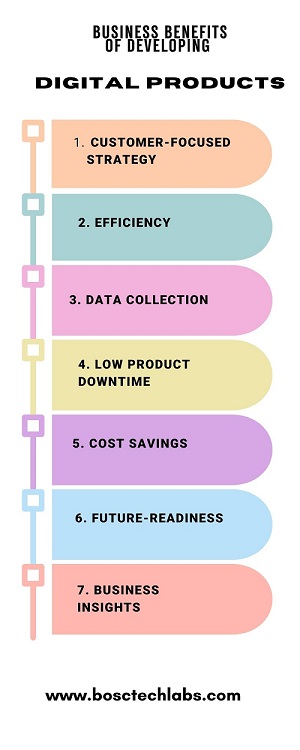
    Business Benefits of Developing Digital Products

    1. Customer-focused strategy: The digital product uses cutting-edge technologies to enhance user experiences.

    2. Efficiency: You have visibility at every development level, lowering workflow friction. With early decisions, it improves workflow efficiency and iterations.

    3. Data collection: To facilitate future experiences, your digital product might retain crucial consumer data like payment details. In addition, it can analyze trends that might lead to the development of new income streams and store other company data.

    4. Low product downtime: The digital product development process makes an early error, bug detection, and resolution possible, boosting the outcome.

    5. Cost savings: You may do business more profitably by continually improving your digital offering in response to consumer feedback.

    6. Future-Readiness: You create a scalable digital product that can be improved continuously in response to increasing customer needs and expectations.

    7. Business insights: Data is gathered and used by the digital product to improve marketing and advertising activities. It promotes brand loyalty while assisting client attraction, providing personalized experiences, and rewarding repeat customers.

    Data’s importance in the development of digital products

    Data is essential to designing and developing digital products because well-informed choices lead to better user experiences, higher customer satisfaction levels, and a greater chance of product success. Data is essential for reasons such as:

    1. Precise decision making:

    Making data-backed decisions fast is possible across the whole lifespan of developing a digital product. The members of your IT team can build and enhance the product more effectively by considering customer demands, preferences, and behaviors.

    2. User-centric strategy:

    Data reveals user pain spots and aids in understanding how consumers engage with your product, what features they find useful, and how you can improve their experience. This is known as a user-centric approach.

    3. Iterative development:

    Digital products gather and analyze data to offer insightful information that aids teams in identifying areas for improvement. They might perform iterative modifications to improve the product and make sure it changes in response to customer input and market demands.

    4. Monitoring performance:

    Data enables the monitoring and measurement of the performance of your digital product. For measuring the performance of your product, you may monitor metrics like user engagement, conversion rates, and user happiness.

    5. Customization:

    You may adapt your digital product to each user’s particular requirements and preferences by using the data that has been gathered. By studying user data, you may customize the product experience, content, and features.

    Process for Developing Digital Products

    The life cycle of developing a digital product includes several phases or stages, each with several procedures or processes. They all work together to make sure your digital product is successful. Although it could change based on your circumstances, the approach below is often followed.

    The following phases are involved in creating a digital product:
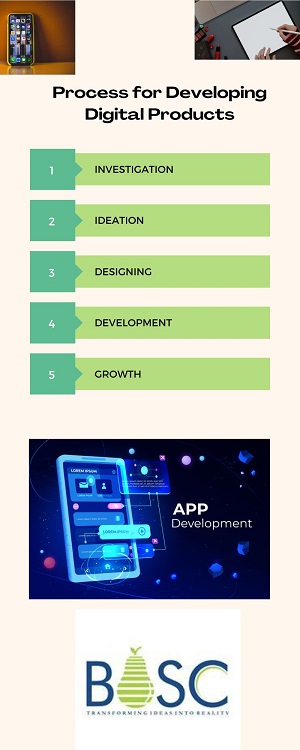
    phases are involved in creating a digital product

    1. Phase 1: Investigation

    It is essential to developing a digital product since it helps reduce risks and identify possible issues early on. Finding gaps and verifying the demand for a solution entails actively engaging end users. This stage assists stakeholders in determining whether their product concept is viable and stops the creation of solutions that do not meet consumer demands. By tackling user pain points from the outset, the discovery process saves time and money. It contains:

    Goals and visions: Setting clear objectives for your project is crucial, as is concentrating on why something needs to be built rather than merely what has to be developed. Interviewing stakeholders and users will help you understand their requirements and expectations. Additionally, it aids in locating chances that support your objectives.

    Product strategy: It’s critical to implement the vision and provide the project team guidance. The strategy is laid in a clear roadmap with specific goals, measurable standards for success and analytics, value propositions, etc.

    Analysing Market: By doing competition analysis, acquiring market data, examining trends, and assessing how your product fits the market, market analysis helps product strategy match market demands and expectations.

    Product analysis with user-view: Analysing your proposed product from the perspective of a specific group of consumers and determining if it offers them value is known as “user-centric product analysis.” The procedure aids in identifying certain features and functions of your product.

    The Product Requirements Document (PRD) and a project roadmap are the deliverables during the discovery stage. They aid in identifying the Minimum Viable Product (MVP) and the necessary features.

    Phase 2: Ideation

    To create a product that satisfies client demands, you brainstorm answers to the issues discovered during the discovery stage. You can explore several solutions and find a solution fit by completely understanding the problem during discovery.

    You may utilize internal brainstorming, the five-whys technique, surveys and feedback, competition analysis, the 6-3-5 method, social media listening, and more to find viable answers. To develop ideas for your digital product, these techniques draw on group cooperation, problem analysis, consumer insights, and creative thinking.

    Phase 3: Designing

    In this phase, you’ll design your digital product’s user interface and experience, including how it will look and what kinds of user experiences it will provide. It contains:

    UX prototyping: To build a user-centered digital product, it is crucial to make a simple prototype demonstrating its functionality and good user experience. This objective is accomplished using strategies like design thinking, streamlined workflows, and tested prototypes. Usability testing allows you to get information from end users and choose the best solutions to meet their needs and preferences.

    Building UI design: Wireframe development is the first step in creating the user interface. Based on user feedback, they went through additional development to become more comprehensive designs. To produce a pleasing user experience, UI design uses visual components, including pictures, color, typography, and layout. It also covers data visualization strategies that use graphs, tables, and charts to show information in a manner that is accessible.

    Deliverables at the design stage of the development lifecycle for a digital product include wireframes, design assets like media, photos, and logos, and style guides like color schemes and fonts.

    Phase 4: Development

    Coding and programming are involved in the iterative process of creating a digital product. At this point, the product design is brought to life by the development team. Utilizing numerous technologies, such as software tools, programming languages, app development frameworks, etc., is what it includes. Utilizing industry best practices, current trends, and a talented development team are necessary for producing a dependable, effective, secure, and scalable product. Creating the necessary features and functionality to make your digital product function is also a part of this stage. They would include the following:

    Software engineering: Whether creating a web, mobile, business enterprise application, system, or platform, this process entails the development team applying their knowledge and expertise to your intended digital result. To satisfy your product’s technical needs, they use a variety of technology services, including Cloud, IoT, Data Analytics, AI, ML, and others.

    Testing for quality and user acceptance: The testing team runs some tests to ensure that the created product functions as intended and satisfies user needs and expectations.

    The Minimum Viable Product (MVP) is deliverable in the development process. It features a user interface and essential functionality that satisfies the fundamental needs noted throughout the design phase. It is the first stage in advanced product development, powered by quicker release cycles, highlighting improvement opportunities.

    Phase 5 : Testing 

    The app is rigorously tested to uncover and resolve any defects, focusing on its functionality, performance stability across various conditions, and compatibility with a range of devices and operating systems.

    Phase 6: Growth

    It’s critical to consider expansion and expanding your audience when you refine your product in response to feedback from the minimal viable product (MVP). The development team may aid in the growth and scaling of your product after its original design and development phases. The following are the steps for building digital goods during the growth stage:

    Learning & Iteration: QA testing continues to be a process even after the initial market releases. At each stage, thorough documentation must be produced. The product’s users will be able to understand and use it if the documentation is completely user-friendly. Continuous testing becomes increasingly important as you keep adding new features. Certain characteristics might need to be adjusted if a step isn’t working properly. Users may ask for more features inside your product.

    Therefore, continuous learning and iterating are crucial until the product is ready for its live launch.

    Ongoing Development: The maturation phase begins after your digital product has been released. It involves adding new features, making updates, providing customer service, and, if necessary, using software engineering. Through this continuous development process, your digital product may grow, keep up with trends, cater to new demands, and improve user experience.

    Evolution & Feedback: Feedback is essential for ensuring that your product continues to meet the needs and expectations of users. It aids in realigning the product with changing consumer demands and industry developments. Therefore, your digital product’s user experience, performance, security, quality, functionality, and other aspects might change.

    Maintenance and Support: Without constant maintenance and assistance, your development procedure would be lacking. You don’t want faults or glitches to damage your product’s reputation once launched. As a result, it is crucial to start planning for this phase immediately. You must set aside resources to continuously maintain your product and ensure it remains useful.

    Top factors to take into account when creating digital products

    To maximize the probability of establishing a successful product that satisfies user demands provides a fantastic user experience, and maintains market competitiveness, you must consider the following elements when developing digital products.

    1. Build Something You Would Use: By utilizing the product yourself, you can be sure it is worthwhile. Consider if it would be valuable to others if you wouldn’t utilize it.

    2. Ensure Accessibility For All Users: It would be beneficial to consider the preferences and needs of people with impairments. Engage with them to learn about their difficulties and implement the required adjustments to increase accessibility.

    3. Make a good user experience: A priority by testing your product and getting user input. It involves finding problems and improving the user experience. Maintain the beneficial qualities of your product while removing obstacles.

    4. Consider Outsourcing To Experts: If your experience is limited, consider outsourcing to a business developing digital products, such as BOSC Tech Labs. They have expertise in supplying high-quality items which you can use. They can turn your idea into a useful digital creation.

    5. Invest in Quality Testing: Extensive testing helps you grasp consumer preferences and demands. Utilise data to direct the development of your digital product, ensuring continued customer pleasure and relevance.

    Conclusion

    Digital innovation is a dynamic field that is always changing. Your company must embrace digital product development to keep up and stay in front. This strategy might encourage innovation and enhance the user experience.

    Understanding the steps involved in building a digital product, how product management should be taken into account before beginning development, and the benefits it offers will help you make educated IT decisions. A good digital product should solve a problem or meet the demand of your target audience, provide a pleasant user experience, and constantly innovate to stay competitive. Connect with us now to get more details about digital product development.

    Frequently Asked Questions (FAQs)

    1. What is a roadmap for digital products?

    A digital product roadmap is a schedule that contains a product’s goals, priorities, and development.

    2. What is the definition of the digital product lifecycle?

    The term “digital product lifecycle management” refers to the process of keeping a product up to date and ahead of the competition by releasing fixes and enhancements based on customer feedback, market trends, and research to make sure the product is profitable, competitive, and relevant for the duration of its lifecycle.

    3. What is the definition of a digital product?

    The development of software-driven user experiences that enhance, in part or entirely, the user journey of an organization is referred to as “digital product development.” Agile development approaches are often used to provide things quickly while testing and iterating frequently depending on feedback from stakeholders.

    4. How much does developing a new product set you return?

    The price of a startup product varies widely based on the sector, firm size, and other elements. However, The average startup product develops for between $5,000 and $10,000. These expenses may be divided into three primary groups: manufacturing, marketing, and research & development.

    Start Your Product Development Today

  • A Game-Changer for the Farming Industry: IoT in Agriculture

    A Game-Changer for the Farming Industry: IoT in Agriculture

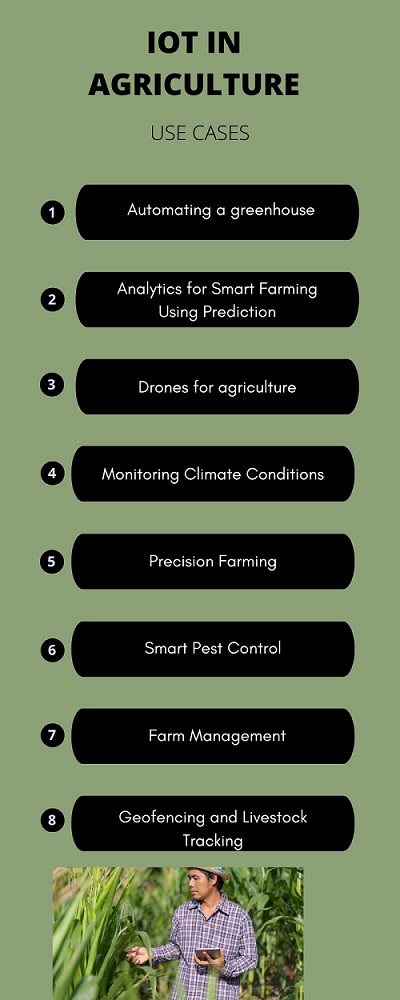
    Technology has quickly advanced in several areas, revolutionising how we live and work. A new wave of innovation has evolved for agriculture with the Internet of Things (IoT) that offers better productivity, sustainability, and efficiency. IoT in Agriculture will improve the management of livestock raising and agricultural production by utilising a network of interconnected devices and sensors that collect and exchange data, fostering predictability and maximising efficiency. Farmers and agribusinesses may make data-driven choices, optimise resource use, monitor crop health, and automate numerous activities by utilising IoT in the agriculture sector.

    In this post, we’ll examine a few Internet of Things applications in agriculture and discuss their advantages. Therefore, this blog is for you whether you’re thinking about investing in smart farming or going to build an IoT solution for agriculture.

    Why IoT Is Necessary for the Agriculture Industry and What Is Smart Agriculture?

    Precision agriculture, also known as smart agriculture, or agrotechnology, focuses on applying innovative technologies and data-driven approaches to enhance agricultural practices and boost productivity. Smart farming improves decision-making processes and maximises agricultural output by utilising the power of automation, connectivity, and real-time monitoring.

    For the industry, IoT offers a network of linked sensors and devices for data collection and sharing. For the purpose of tracking temperature, humidity, soil moisture, nutrient levels, and animal behavior, they can be embedded in soil, crops, machinery, and livestock. Additionally, the data is analyzed and used to influence decisions about fertilization, disease prevention, irrigation, and normal farm management. For instance, farmers can now monitor crop health and soil conditions using real-time data from their cell phones or tablets. Accurate information facilitates effective decision-making to maximize fertilizer use as well as optimise farm vehicle routes. To learn more about how IoT can help your farm, get in touch with us today.

    Market Size of IoT in agriculture

    The market size for IOT in agriculture was estimated at $27.1 billion in 2021 and is expected to increase to $84.5 billion by 2031, with a predicted CAGR of 12.6% between 2022 and 2031.

    Connecting physical objects and devices to the internet so they can communicate and collect data is a key component of the IoT in agriculture, a business that is rapidly growing. Then, by using this data, it is able to develop new products and services, automate processes, and boost productivity.

    Influence of the Industrial Internet of Things on Agriculture

    The agriculture industry has been considerably impacted by industrial IoT (IIoT). Today, it is transforming conventional farming methods and welcoming forth a new era of smart agriculture.

    Some of the significant effects of IoT in agriculture are listed below:

    • Remotely tracking soil conditions, weather patterns, crop health, and equipment performance can increase efficiency and yield.
    • By adjusting watering schedules based on real-time data, intelligent irrigation systems can improve resource management and make sure that crops are watered appropriately and at the appropriate times.
    • Continuous crop monitoring is made possible by improved disease detection and crop monitoring, which enables farmers to spot early indications of disease, nutritional deficits, or insect infestations.
    • Environmental factors are tracked in real-time using livestock monitoring and management to keep an eye on things like body temperature, heart rate, feeding habits, and location.
    • Farmers can use insights from data-driven decision-making to optimize production processes, fine-tune resource allocation, and reduce risks.
    • From field to fork, data collected along the value chain may be recorded and analyzed to ensure transparency, quality control, and food safety. Supply chain optimization with end-to-end visibility and traceability throughout the agricultural supply chain.

    IoT in Agriculture Use Cases

    Here are some practical examples of IoT applications in smart farming that are revolutionizing the way farms run by empowering farmers to optimize resource use, automate procedures, and make data-driven decisions.

    1. Automating a greenhouse:

    It requires the use of IoT sensors and actuators. They keep an eye on and regulate important environmental variables like lighting, humidity, and temperature. IoT enables attentive cultivation, speeds up plant growth, and increases overall greenhouse productivity by maintaining ideal conditions.

    2. Analytics for Smart Farming Using Prediction:

    IoT provides farmers with predictive analytics by gathering and analyzing data from a variety of sources, such as weather patterns, soil moisture levels, and crop health sensors. Making informed judgments about irrigation, crop rotation, disease prevention, and resource allocation is made possible by this input.

    3. Drones for Agriculture:

    IoT sensors and cameras help collect information on crop health, plant density, and watering requirements. The farmers may use it to analyze and pinpoint problem areas, take preventative action, and improve their farming methods. It results in higher yields and less waste of resources.

    4. Monitoring Climate Conditions:

    By installing IoT weather stations throughout farms, precise data on temperature, humidity, wind speed, and rainfall are collected. Real-time decisions about crop management, pest control, and irrigation schedules can be made using this input.

    5. Precision Farming:

    Combining data from several sources, including soil sensors, satellite photography, and machine vision, enables precision farming. Additionally, this data-driven methodology gives farmers the ability to optimize pesticide and water use for improved crop yields.

    6. Smart Pest Control:

    Using sensors and image recognition software, IoT devices can accurately detect pests. Farmers may apply targeted pest control strategies thanks to early detection, which minimizes crop damage and lowers the need for excessive pesticide use.

    7. Farm Management:

    Using these systems, farmers may gather and organise all of their data in a convenient place. The system serves as a central location for scheduling activities and maximizing resource use, gathering data on everything from agricultural yields and livestock records to finances and inventory levels.

    8. Geofencing and Livestock Tracking:

    Using IoT-enabled tracking tools, farmers can keep an eye on where they are and the behavior of their livestock in real time. They can use geofencing to create virtual borders and receive notifications when animals go outside of predetermined parameters. With the use of this technology, grazing patterns are better managed, improving animal welfare.

    IoT benefits for agriculture

    The Internet of Things (IoT) gives farmers the tools they need to face the challenges of feeding a growing population while assuring a more sustainable future for agriculture, from enhancing efficiency and decreasing waste to enabling precision farming and enhancing product quality. Let’s examine the main advantages of IoT for agriculture:

    1. Reduced Wastage and Effective Cost Management:

    By identifying anomalies and irregularities in crop production, IoT solutions in farming play a critical role in risk mitigation and minimizing wastage. Farmers may act right away to reduce waste and successfully control expenditures.

    2. A Cleaner Environment with a Greener Approach:

    Precision farming techniques enable farmers to use fewer pesticides and fertilizers, contributing to a cleaner environment. It would increase the output of organic crops. Additionally, by using an eco-friendly strategy, agriculture projects can reduce their overall carbon impact while still producing high-quality crops.

    3. Process Automation has Increased Efficiency:

    In the agricultural sector simplified a number of farming practices, including demand-based fertilization, irrigation, and robot harvesting. By streamlining these tasks, farmers may boost production, save time, and optimize their operations.

    4. Optimizing Resource Usage for Sustainable Agriculture:

    IoT precision farming enables farmers to retrieve real-time data from sensors installed across farms, resulting in optimized resource use for sustainable agriculture. With this information at their command, farmers can decide how best to distribute resources, ensuring that their crops receive the appropriate quantity of water, fertilizer, and other crucial inputs.

    5. End-to-end Control of the Production Method:

    Using predictions and real-time monitoring systems, farmers can react quickly to changes in the weather, air quality, and humidity. They are able to prevent potential losses thanks to this degree of control, which also promotes a more effective crop production cycle.

    6. Improved Data Collection for Enhanced Farming Efficiency:

    In the face of changing weather patterns and deteriorating soil conditions, farmers work to produce more on land that is getting smaller. Fortunately, they can now monitor their crops and environmental conditions in real time with the help of IoT-enabled agricultural technologies. By quickly gathering vital information on weather, land conditions, livestock, and crop health, farmers can get insightful knowledge and anticipate future problems. They can increase their farming efficiency by making well-informed judgments and taking proactive measures to fix problems as they arise.

    Before developing your smart agriculture solution, take into account the following.

    Here are some crucial factors you should take into account before making the investment in an IoT-based smart farm system:

    1. Interoperability and Integration:

    It is crucial to evaluate how well the suggested solution will work with the current farm machinery, equipment, and systems as part of the process. The developed solution must be able to work with other platforms or technologies you already use. Importantly, efficient data transmission and streamlined farm management procedures will be made possible through seamless integration and interoperability.

    2. Data Privacy and Management:

    Smart agricultural technologies produce a lot of data. Think about the collection, management, analysis, and storage of the data. To secure sensitive information about your farm operations and to maintain compliance with relevant necessities, address data privacy and security concerns.

    3. Vendor Selection:

    In this instance, selecting a reputable and skilled vendor or technology provider would be the last step. Consider their track record, reputation, customer support options, and accessibility to continuous technical support before accepting me on board. It is critical to assess their capacity to offer ongoing support, system updates, and troubleshooting.

    4. Farm-specific Requirements:

    Understanding the unique demands and problems of your farm is essential. Finding the areas where technology can make the biggest improvements is a crucial first step. It would involve supply chain optimization, agricultural monitoring, animal tracking, and irrigation management.

    5. Scalability and Flexibility:

    Take into account the solution’s capacity to adjust to your farm’s evolving needs as it expands or diversifies its business. It is crucial to make sure the solution can support expansions in the future, extra sensors or devices, and developing technologies.

    6. Environmental and Regulatory Aspects:

    Consider into consideration any potential environmental or regulatory requirements that could affect the adoption of innovative agricultural solutions. It is crucial to make sure that data gathering, water use, and pesticide application comply with local laws, permits, and environmental restrictions.

    Conclusion

    Farmers and ranchers can now practise smart farming because of the Internet of Things. A high-tech, capital-intensive process. Smart farming offers two advantages: it allows farmers to spend less time in the fields while yet increasing crop yields. Numerous uses for the IoT-based ecosystem exist in the agricultural industry.

    Hence, due to IoT-enabled agriculture farmers have been able to close the gap between crop quantity, output, and efficiency. Making quick and efficient business decisions with the least amount of crop loss is made possible by the real-time data obtained, collated, and imported from several sensors and saved in the database.

    We handle the complete lifecycle of Internet of Things (IoT) initiatives as an experienced provider of mobile application development services, from requirement engineering to architecture design and platform & app development to testing & support. It includes connectivity technologies, protocols, standards, IoT platforms, and sensors with the assistance of the development languages and frameworks.

    Frequently Asked Questions (FAQs)

    1. How will IoT impact agriculture in the future?

    Reduction in cost determines the health of their herds, forecasts crop water needs, and gathers environmental and machine data with the aid of the farm IoT devices. There will be fewer visits to check on crop spraying, equipment performance, and the state of the arable land according to an IoT-based agriculture monitoring system.

    2. How can IoT boost productivity in the agricultural sector?

    Data from sensors can be used to monitor a variety of company metrics, including employee productivity, equipment effectiveness, and more. IoT makes agricultural processes easier to manage. There are consequently fewer production hazards. It makes it possible to predict output outcomes, and this helps farmers in better planning and product distribution.

    3. What is smart agriculture based on IoT?

    IoT-based smart agriculture is the practise of implementing IoT technology for improved farming practises. In order to facilitate data collecting, analysis, and automated decision-making in farming operations, it incorporates sensors, actuators, and other smart devices.

    Book your appointment now

  • A Comprehensive Guide of API Development in 2026

    A Comprehensive Guide of API Development in 2026

    The significance of Application Programming Interfaces (APIs) in software development cannot be emphasized. APIs have developed into crucial building blocks that provide programmers the freedom to create feature-rich, flexible, and scalable programs. This comprehensive guide aims to provide readers with a basic understanding of API development so that both beginner and experienced programmers can benefit greatly from APIs in their work.

    This guide will cover the principles of API design in detail, along with the best practices and accessible tools. The concepts, categories, and protocols involved are some of the matters covered. We’ll begin by describing the role APIs represent in modern software development and how they make it possible for different program components to communicate with each other effortlessly. Then, we’ll look at the unique characteristics and ideal use cases of the various API formats, including RESTful, GraphQL, and SOAP.

    The fundamentals of API design will then be discussed, with a special emphasis on the security, scalability, and maintainability of APIs. We will go over the implementation of common authentication and authorization techniques, rate limitation, and API versioning, among other important topics. Finally, we’ll discuss the most well-liked frameworks and tools for developing APIs and the value of testing and documentation. We’ll ensure you have the information and tools you need to establish secure, efficient, high-quality APIs. To gain a thorough overview of API development, grasp this blog.

    Application Programming Interface (API): What does it mean?

    The main query that will come up before starting is: What is an API? How will it operate? Following a set of rules, requirements, and standards known as an API (Application Programming Interface), an application or software can utilize features or services from other apps, gadgets, or platforms. This makes it possible for the program or app to offer better services.

    The transfer of data between two software programs is made possible by this collection of computer programs. Also included are the conditions and terms of this data exchange.

    Application Programming Interfaces Have Two Elements:

    • With requirements finalized in the form of requests for processing and data delivery protocols, the technical document describes the data exchange possibilities across solutions.
    • Interfaces for software that follow the specification that defines them.

    The API of a piece of software is used when that software needs access to data or features. It outlines the circumstances in which the capability or data must be available. The data functionality that the first application requested is all that the other piece of software does. API also refers to the connection interface between these two programs.

    Each API is implemented via function calls, language constructs that command the software to do particular services and tasks. Function calls are nothing more than verb and noun-filled sentences. A description of function calls is also provided in the API documentation.

    There are many purposes for APIs. They frequently make custom software development easier or faster. Programmers use APIs to incorporate functionality from external sources into already-developed applications. They can also build new applications by relying on third parties.

    How important is API?

    Every app that works with data or enables communication between products or services is built on an API. It enables a mobile application or platform to share its data with others without needing mobile app developers, enhancing user experience. Additionally, APIs eliminate the need to build a comparable program or platform by allowing you to use the existing one or another app/platform in its place. These factors force the developers of apps and executives to concentrate on the API development process.

    Which features define API development?

    The following API features should be taken into consideration while developing a secure mobile application:

    1. Identification and verification

    The act of validating the right identity is referred to as authentication. On the other hand, authorization refers to determining whether the verified user has the authority to perform a specific action on a source. As an illustration, John (a confirmed user) can only acquire resources; he cannot create them.

    OAuth, OAuth2, and JWT are the most widely used protocols for authentication and authorization.

    A mobile application needs the most crucial API features are modification timestamps and search by criteria. An API should allow users to search data based on different criteria, such as a date. Following initial data synchronization, we immediately consider modifications (updates, edits, and deletions).

    2. Paging

    Sometimes we don’t need the complete file, only a quick glimpse at the latest data. In this case, the API should decide how frequently and how much data to present. The user should also know how many data pages are still accessible.

    3. Caching

    Cache By creating an approach for caching information, you can retrieve resources rapidly. The cost of your requests will decrease once the data has been prepared in an in-memory database. Programs like Redis and Memcached can be used to build a caching strategy.

    4. Packages

    Language-specific packages or containers are known as API wrappers. They combine numerous API request groups into simple techniques. The wrapper also makes several API calls without contacting the user.

    5. Error management

    Effective error handling makes it simple to identify whether a client error or a server malfunction caused the problem. While the customer can alter the request in some error-related situations, they must contact assistance in others. Here are a few effective methods for managing errors:

    • Use error codes that follow established standards.
    • Giving the right number of errors.
    • Determines the main cause of the issue.
    • Splitting it into domain-specific and general issues.

    6. Testing

    API testing and software testing are very similar. API testing involves testing the APIs and the integration testing portion of the process to see if they meet the performance, functionality, security, and reliability requirements. JMeter, Postman, and SoapUI are used most frequently for API testing.

    How Does API Work?

    • The API contains a sizable number of rules. API enables apps or software to communicate with other devices through those regulations. The application programming interface is placed between them to connect two programs or apps for a specific task.
    • You can connect to Facebook via a mobile app. Through API, the mobile application will access data from the Facebook server. It is a simple procedure. The Application Programming Interface enables us to access the Facebook server’s credentials.
    • Imagine you went to a website to book a train ticket. You completed the details. After accepting your details, the application will provide the train and ticket information on its page. From the original Government website, we got all of the data.
    • The use of APIs is not just restricted to web APIs. For every system or software, numerous different APIs serve as an interface. The retrieving website or method receives a request from the application programming interface to get their database. A website or application of software can serve as an endpoint, and an API can connect them both.
    • Application programming interfaces operate using SOAP and REST protocols. Application programming interfaces using SOAP are completely platform-dependent.

    How many kinds of APIs?

    According to the way they handle releases, APIs can be categorized.

    1. Individual APIs

    This application software’s interfaces are created to improve the company’s services and products. Developers inside and outside the organization can utilize these APIs to build new solutions.

    In this instance, the app is open to the public, but only those connected to the API publisher can access its user interface. The company can control how the API is used by putting a private strategy in location.

    2. API Partners

    Partner APIs are used in software integration between two parties. In addition, they are freely advertised and given out to the business partners who have signed the publisher’s contract. A company can create new revenue streams by giving its partners advantages in terms of capabilities and access to data.

    In the interim, they can also monitor how exposed digital assets have been used. They also examine the user experience of third-party applications that use their APIs. They also ensure that the corporate identity of their apps is maintained.

    3. Public API

    External or public APIs are other names for developer-oriented public APIs. These APIs are also accessible to other programmers. Through the public API program, you can sell your brand. Furthermore, if done correctly, it allows you to increase your income.

    Open APIs and commercial APIs are the two subgroups of public APIs.

    The Open API declares that all its features are available and have no usage restrictions. It also specifies that the documentation for the API and its description must be available. Additionally, it emphasizes that free application development and testing should be possible.

    Customers have two payment options for commercial APIs: membership fees or pay-as-you-go. Publishers also provide free trials so customers can test out APIs before subscribing.

    4. Integrated API

    Composite APIs are widely used to integrate various service and data APIs. They are made by combining pre-existing API methods that allow users to perform several operations with just one call. This accelerates execution while enhancing listener performance in web interfaces.

    Which terminologies are related to API?

    API Key: When an API request utilizes a header or parameter to identify the requester, the allowed code included in the request is referred to as an API Key.
    Endpoint: An endpoint is a communication channel between an API and another system.
    JSON: JavaScript Object Notation, or JSON, is a format for API response bodies and request parameters.
    GET: To obtain resources, the RESTful application program interface uses HTTP.
    Post: The RESTful API creates resources using this HTTP method.
    OAuth: This open standard authorization technique allows users to gain access without explicitly disclosing their credentials.
    Latency: The time it takes for an API interface to process a request and deliver a response is called latency.
    Rate-Limiting: API rate-limiting limits the speed at which an end user can access the APIs. In other words, it refers to simultaneously capping the quantity of API calls a user can make.
    Throttling in API: API throttling is the process through which a consumer’s use of an API is limited for a certain period.

    Tools to develop APIs

    When it comes to API development, there are numerous tools accessible. The following list includes some of the most popular API tools and solutions used by developers to create APIs:

    1. Apigee

    Google’s Apigee is a management tool for API development. This solution is useful when a business is modernizing its older apps or simplifying the transfer of data across apps and services. In addition, it helps professionals when they create connected apps.

    2. Dredd

    An HTTP API testing framework is called Dredd.It is used to verify the backend description of an API. It verifies whether the API has been validated by carefully examining the description of the API.

    3. APIMatic

    For website APIs, there is a platform called APIMatic. Engineers use it to create SDKs for their APIs across ten platforms. Additionally, it’s utilized to keep it up-to-date with API upgrades.

    This application allows app developers to convert API descriptions into other formats, such as IO Docs, API Blueprint, Postman Collections, HAR 1.4, WADL, Swagger, RAML, and OAI format.

    4. Sandbox

    Sandbox provides a quick and simple fake RESTful API. Sandbox is generated from API definitions. Additionally, it lowers the expense and risk of using a third-party API when testing.

    5. Postman

    App developers can evaluate the API’s performance using Postman, which tests and documents the API. Additionally, it is an interactive tool that may be automated.

    6. SoapUI

    An open-source testing tool is SoapUI. It is cross-platform compatible. It may also automate functional and non-functional tests, in addition. It is utilized for Web API regression, compliance, execution, security, and load testing.

    7. Swagger

    To build APIs, an open-source framework named Swagger is utilized. Well-known technological businesses like Getty Images, Apigee, PayPal, and Microsoft use Swagger.

    8. JMeter

    The open-source software is JMeter. It is used in performance testing of RESTful APIs.

    Best Practices for API Development

    APIs can help your business grow positively. It develops websites, mobile applications, operating systems, and software. On its server, it has a library of books on API development. There is also a PDF for API Development.

    1. Utilize the HTTP Methodology

    Before implementing the HTTP methodology, you must develop a strategy. You must be familiar with the various HTTP method types for that. POST can be utilized to create resources. Additionally, you can update data on already-existing resources. And GET is used to get information.

    2. Leverage formal systems

    CRUD-based systems are used via REST Application Programming Interface. For creating, reading, and updating, there is CRUD. The Hypertext Transfer Protocol (HTTP) is used for this method. This method enables web development companies, iPhone & Android application development companies, etc., to interact with external systems’ data as if it were an element of their own.

    3. Can Stay Current With API Changes

    The most recent alterations to your application programming interface can be tracked. You will be notified every time the Application Programming Interface is updated or added to. Every single API detail is documented. So that using it won’t make your users feel dated.

    4. Maintain versioning

    Make sure you are familiar with all the information in the new versions. To verify that impending modifications won’t impact them, users should be able to check earlier versions of your APIs. Make sure that the HTTP header is present on all new APIs.

    Conclusion

    It is safe to conclude that APIs now have more significance than previously in terms of software development and business collaboration. The essential technology connection APIs provide has been demonstrated to boost business earnings.

    If you require the best API development services, contact our experts at a reputable mobile app development company in the USA. They will guide you through the entire process of developing a secure API.

    Frequently Asked Questions (FAQs)

    1. What Is the Lifecycle of an API?

    The API lifecycle has three main phases: create, control, and consume. You develop and document your API during the creation phase. You put security policies in place during the control phase. Additionally, you publish and monetize APIs throughout the consumption phase.

    2. What is backend development for APIs?

    An API for backend services, such as servers, enables communication between programmers and backend services.Many options are accessible when selecting a backend API. It would be best to keep a few things in mind to achieve your objectives.

    3. What are SOAP API and REST API development?

    The REST (Representational State Transfer) API is an architectural style for software that specifies all the restrictions that must be followed when creating Web services. The SOAP (Simple Object Access Protocol) protocol is far more complex than REST since it incorporates several standards, including security.

    Book your appointment now