• Flutter Vs. React Native: Which is Best For your Project in 2026?

    Mobile application development is growing at a very fast pace of time. The new lifestyles and the latest methods of communication have raised the demand for mobile apps. But it is creating the app for iOS and Android, meaning you need two different teams with various skill sets. However, with the help of the cross-platform mobile app development framework, it is easy to develop an app for both platforms with a unified codebase.

    Cross-platform mobile apps platforms such as Google’s Flutter and Facebook’s React Native are two of the latest topics to debate when selecting hybrid app development platforms. But deploying the app on Apple Store or Google Play Store is the need of every business. However, shipping in the app market and selecting the correct technology stack is the most important step to take wisely. However, when we discuss the two most renowned platforms, React Native and Flutter, it is very difficult to find the most suitable for your project. But before going on any discussion, let’s discuss both these frameworks in detail.

    What is Flutter?

    Flutter is an open-source, cross-platform mobile application development framework that uses Dart language. As Google introduces Dart and Flutter, the business industry uses this framework to create robust and big-size enterprise apps easily. However, due to its huge capability of cross-platform app development, Flutter has gained much popularity in a very short time. Hence, it has given birth to many mobile apps which are getting appreciated by people.

    What are the benefits of Flutter App Development?

    1. Hot Reloading

    The hot reloading feature perfectly matches Flutter’s nature, which is the major advantage of utilizing Flutter for streamlining cross-platform development. However, with the help of this feature, the programmers can make the changes quickly, make instant tweaks, and then merge the updated elements. Hence, this approach has necessarily streamlined the development process and will make bug fixing easier.

    2. Embedded Application Builder

    The built-in app builder is another benefit of Flutter app development. Hence, this tool has many pre-developed UI elements that the developers must merge and customize. An app builder is flexible and allows creative and non-patterned ideas.

    3. Codebase Sharing

    Flutter-build applications can share the code between iOS, Android, and various other platforms by eliminating the requirement to rewrite it from scratch. Hence, this feature makes Flutter a great choice for MVP development. With this, the developers can deliver the app with a close-to-native look, test it with the targeted audience, and decide on the necessity of making a native application.

    4. High Productivity

    As Flutter is cross-platform, you can use a similar codebase for the iOS and Android apps. Hence, it will save time and resources.

    5. Great Performance

    Dart compiles into the native code, and there is no requirement to access the OEM widgets, as Flutter has its own. There is less mediated communication between the app and the platform, as Flutter is the SDK that gives reactive views without needing a JavaScript bridge. Hence, it contributes to the fast application startup times and the very few performance issues.

    6. Compatibility

    As the Flutter widgets are part of the app rather than the platform, you will get less experience or no compatibility issues on the various OS versions. Hence, in turn, less time is spent on testing.

    What is React Native?

    React Facebook launched Native. It is the most preferable and well-known cross-platform mobile app development framework. Hence, React Native uses JavaScript and simplifies Android and iOS app development with a single codebase.

    What are the major benefits of React Native App Development?

    1. Code Reusability

    The major benefit of React Native is that programmers are not required to make different codes for multiple platforms. However, approximately 95% of the code can be reused between two platforms, which helps to increase development speed and efficiency considerably. Thus, you will get a faster time-to-market with fewer maintenance efforts.

    2. Native look and feel

    React Native Components merges the blocks from a native user interface with their JavaScript and gives an app a native-like appearance. Moreover, by creating the blocks for the same iOS and Android, the look and feel of the app will be the same across the two platforms.

    3. Live Reload

    The live reload feature of React native permits you to view and work with the changes in real-time. You can fix the code while an app is loading and it reflects in the application with the automatic reload feature. Hence, reload the particular change area to save time on a compilation.

    4. UI Focused

    React Native makes use of the React JavaScript library to create app interfaces that are fast and responsive. It has great rendering abilities and utilizes the component-based approach, making it easy to make simple and complicated UI designs.

    Also Read: Top 10 Most Used React Component Libraries in 2022

    5. Cost-Efficiency

    As code is reusable in React Native, it helps you save up to 40% of development costs. Hence, you do not have to hire the two various Android and iOS developers to make the application. Therefore, the pre-built components in React Native will fasten the development process.

    6. Third-Party Plugins

    Developing the app from scratch is expensive; React Native gives several third-party plugin options, including JavaScript-based and native modules. Therefore, the third-party plugins alienate a requirement for the particular web view functions, and it helps to enhance an app’s functionality and performance.

    React Native Vs. Flutter: Which is the Best Cross Platform Mobile App Development Framework In 2023?

    Both React Native and Flutter is the renowned platform for cross-platform mobile app development. Hence, both have their benefits. So, let’s compare Flutter and React Native with the different criteria.

    1. Programming Language

    React Native uses JavaScript to make the user interfaces. It is easy for web developers to work with React Native because of its robust popularity of JavaScript. JavaScript is the highly preferable and the selected programming language among the programmers, and also it simplifies training the development team to work on React Native.

    On the contrary, Flutter uses the Dart language, which Google launches. As it is a client-centric language, Dart gives various benefits. Hence, Dart enables the assembling of famous OOP languages such as C++ and Java. You will easily get the command over Flutter if you have complete knowledge and understanding of any OOP language.

    2. Architecture

    In React Native architecture, JavaScript builds the bridge between the Native language and JavaScript. It works through the two-sided conversation by sending the JSON message. Hence, due to an asynchronous message transmission, it needs a smooth user interface for the app. However, React Native app development has the chance of lagging UI in the end as the bridge affects rendering speed.

    In Contrast, Flutter is a package that does not need any bridge to communicate with the native components. Hence, it has everything within itself, such as the Cupertino framework, materials design, etc. The Flutter benefit makes an app more predictable and robust to perform on various platforms than React Native.

    3. Installation and Configuration

    React Native gives an easy configuration process. You can Install React Native CLI globally with the help of the command line. In addition, you need to install Yarn and NodeJS as the package manager. You can install Flutter by downloading the binary for the specific mobile platform and adding it to your PATH variable. Hence, it can be easily done by the command line. Therefore, Flutter goes one step down in the installation phase, as the installation procedure is not as straightforward as React Native.

    4. Development Tools and Documentation

    React Native is robust, and developers with experience with JavaScript can use this framework. For example, essential features like navigation need to be better documented. So, finding the info about creating native libraries can be troublesome.

    In comparison to React Native, Flutter has a rich set of documentation. It gives in-depth guides in video and graphics format. The best thing about Flutter is that it has multiple tools like the Flutter inspector and debugger, which aids you in the mobile app development process.

    Schedule an interview with React developers

    5. User Interface

    Due To the JavaScript bridge, React Native renders a native component for single platforms. A user interface gives the look and feel of the mobile application. React Native provides readymade elements that behave like an app’s building block. Hence, it is toughest to replicate the complex UI in a React Native app. Flutter gives the UI widgets packaged within itself, which simplifies the native mobile app development. Thus, it eliminates the requirement for third-party libraries as it has a huge set of framework widgets. Besides that, Flutter apps are constant across all platforms.

    6. Developers Productivity

    React Native gives the functionality of reusability across all platforms. You can use many libraries created by the development community as the building blocks to fasten the mobile app development procedure. Moreover, React Native has a hot reload feature that will show the app changes without recompiling them. On the other hand, hot reload in Flutter will simplify an app iteration and get feedback instantly. Hence, Flutter gives fast app compilation.

    7. Community Support

    A large community matters when we talk about open-source mobile app development frameworks and React native has all this functionality. It is the best cross-platform mobile app development framework which Facebook launched in 2015. In comparison, Flutter has a very smaller community than React Native. But, later on, Flutter gained massive popularity among tech professionals and grew quickly.

    8. CI/CD Support

    React Native does not support the CI/CD solution for Google Play Store and Play Store delivery. Unfortunately, manual deployment for Google is well-documented. You require a third-party solution to automate your app deployment procedure. On the contrary, Flutter has a well-defined documented guide to develop and deploy the app on the Android and iOS platforms. Therefore, it enables an app deployment via the CLI, and in the case of any advanced customization, it permits third-party integrations.

    Schedule an interview with WordPress developers

    Conclusion

    In the Flutter Vs. React native, as there are no winners or losers. Every framework has its benefits and drawbacks. Some experts assume that Flutter is the future of mobile app development. At the same time, React Native will stay complicated and contend with some of the remarkable advantages and impressive React Native-based apps that are accessible in the market. Therefore, it is dependent on your budget and project specification.

    At Bosc Tech Labs, we work both on React and Flutter frameworks. Let us know if you are interested, and we will reach out as soon as possible. Consult us if you want to hire React developers or hire Flutter developers.

    Get in touch with us today!


    Frequently Asked Questions


    1. Which server is considered best For Flutter app development?

    Firebase is a Google-Powered backend service that will work great as the Flutter server-side. This platform gives various development tools that expedite mobile and web development assignments. Hence, it is well-known for the JSON-enabled NoSQL database, which saves and syncs the data in real time.

    2. Should I use React Native or Flutter?

    The Flutter framework comprises UI rendering components, device access APIs, testing, and navigation. In comparison to that, React Native must rely on third-party libraries to access most native modules. Hence, for better performance, you should opt for Flutter.

    3. What makes Flutter better than React Native development?

    Flutter relies on the developed widgets for customization, whereas React Native incorporates third-party customization components. Hence, Flutter delivers the most compatibility. Moreover, Flutter development is constructed on widgets, whereas React Native uses JSX.


    Consult Our Experts

  • Adding SVG Images In Flutter App

    Adding SVG Images In Flutter App

    In general, adding SVG images includes essential components. SVG images play an important role and are the major parts of this application. These factors are highly used to implement respective logic for the corresponding application.

    Apart from that, the SVG images were retrieved even though they also stored the SVG image state within the database. The SVG image is considered the conceptual and physical separation in small applications. It is also associated with the classes. It takes the work of the SVG image.

    Maintain user interaction

    SVG images are the most important components because it helps to maintain user interaction. With this help, people ultimately select a view within the Flutter app development.

    Adding SVG images helps display information, even though it has input and interaction responsibilities. It also involves handling query string values. At the same time, it supports passing the respective values to the corresponding SVG image, which is highly used to query the database.

    Views are essential components because it helps to display UI (user interface). In general, the UI is also created from SVG image data. It helps with the checkboxes depending on the current state.

    Includes different aspects

    Normally adding SVG images also supports creating applications based on your needs; it includes different aspects like input, UI, and business logic. This pattern is also highly used to specify different kinds of logic.

    The UI logic also belongs in the view. At the same time, the input logic also belongs in the respective SVG images. On the other hand, the business logic always belongs in an SVG image.

    In general, the loose coupling of adding SVG images supports parallel development, which means if one person or developer works with the logic of the SVG images, other developers can work with the view. Even the third developer has the chance to pay attention to the business logic of the respective SVG image.

    Consider the following factors

    If you are going to add SVG images, you need to consider the following factors carefully. It is the most important aspect of implementing the respective web application development. With the help of this, you can experience web forms-based applications that are highly used to work exactly. Before going to using SVG images as well as web forms, SVG images consider the approaches and advantages.

    Important benefits of adding SVG images

    The framework is designed to overcome all the drawbacks; it allows you to plug in your URL routing policy, view engine, and action-method parameter. Adding SVG images also supports taking the benefits of the dependency injection even though it is used in the inversion of control.

    It generally enables a user to create the respective object within the application. This process also helps to make testing much simpler as well as easier.
    At the same time, it offers extensive support because the powerful URL-mapping component gives great opportunities to build applications. In addition, it makes the process understandable and searchable URLs.

    You do not need to add the file-name extensions, but it shares support for naming patterns. It is high in the Flutter app representation.

    Use SVG images effectively

    In this process, you can get support to use SVG images, even if it helps to view templates. With this help, you can easily use the existing features such as master pages, declarative server controls, in-line expressions, templates, data binding and many others. Furthermore, it supports forms authentication as well as windows authentication.

    In addition, you can use this for the roles, output, URL authorization, data caching, membership session, and profile state management. It is vital in the configuration system, health monitoring, and provider architecture.

    And one more benefit is the user does not need to have the program for SVG images on their computer. They can get it from the internet, so it will be easy to add the SVG images. The spam bots will not snoop on the SVG image address. And the best thing is the other person will not be able to add the virus through SVG images, even in an accident.

    Process of adding SVG images from the Flutter app

    As technology develops in many fields, many business people use the SVG image service. They use this SVG image service to get many potential customers and sell their entire product effectively.

    The SVG images are the latest avatar in the world of communication and chatting, and people grab the opportunity of using it to its utmost. If you go for the best SVG image, you will be in an advantageous position, and there is hardly any doubt.

    There are best reasons people should avail of the service, and you must deal with the things individually. And if they find it cheap and of superb quality, they will waste a minimum of time grabbing it.

    Why Is Flutter Popular In Mobile App Development?

    Avail of the services

    The SVG image service from the best company is quite affordable so that people of even more income can avail themselves of the service whenever they want.

    It is seen that a handful of people have used it for marketing and for promoting their products and company’s brand in a minimum of time. Thus, they have adopted the trick of adding this huge SVG image deluge and thus making their inbox appear clumsy and cluttered.

    Use in Flutter app

    Knowing the complete process of adding the SVG images will be more helpful for the user to add the SVG images effectively. Knowing all the procedures, like creating the Flutter app and then adding the SVG images using it, is the easiest way to add the SVG images.

    With the help of the other person will not be able to add the virus containing SVG images. So by following the above procedure, create your Flutter app and add the SVG images.

    Steps:

    Step 1: Add dependency

    	
    dependencies:
       flutter_svg: ^1.1.6
    

    Step 2: Get the dependency by

    	
    flutter pub get
    

    Step 3: Import plugin

    	
    import 'package:flutter_svg/flutter_svg.dart';
    

    Step 4: Use in the code, from asset by

    	
    SvgPicture.asset("assets/alarm_icon.svg");
    

    Step 5: From network

    	
    SvgPicture.network("");
    

    Step 6: Sample Code

    	
    import 'package:flutter/material.dart';
    import 'package:flutter_svg/flutter_svg.dart';
     
    class HomePage extends StatelessWidget {
      const HomePage({super.key});
     
      @override
      Widget build(BuildContext context) {
        return Scaffold(
            body: Center(child: SvgPicture.asset("assets/alarm_icon.svg")));
      }
    }
    

    Output

    Schedule an interview with WordPress developers

    Conclusion

    Using the SVG files is an excellent addition to the Flutter app development, but there are better answers to all your image problems. Observing the use cases and measuring an app’s performance with the SVG images is necessary, as there may be a need to replace the SVG image with the other standard image format like JPEG or PNG. A flutter_svg package gives a fast performance and is simple to use.

    Get the Knowledge of Flutter App with Bosc Tech Labs Resources. They will guide you throughout the process, help you add the SVG images, and know the perfect way to Flutter development. You can also hire Flutter developers ready to help you in every manner!

    Let’s get connected !

    Frequently Asked Questions (FAQs)

    1. What is the primary benefit of using SVG files?

    SVG images can be built and edited with any text editor. They can also be searched, indexed, scripted, and compressed. These images are scalable and are printed with high quality at any resolution.

    2. Why does Flutter development not support SVG?

    The SVG directory is in the code of Skia, and it is the primary component of Flutter development. However, Skia serializes the images into SVG files. Hence, it is impossible to decode or render the SVG images through the Skia.

    3. IS SVG based on the resolution?

    SVG provides, indeed, resolution-based techniques for presenting graphics on the web. The vector graphics format uses XML to define the primary properties like shapes, paths, colors, and fonts. It has more advanced features like gradients, filters, animation, and scripting.


    Book your appointment now

  • What is Showcaseview In Flutter?

    What is Showcaseview In Flutter?

    ShowCaseView is a simple and reliable package allowing identifying the different features of the application. The basic use of the ShowCaseView package consists of the target element. These can be easily passed with inputs that are highlighted on the translucent background. It is easier to pass the custom widget in ShowCaseView.

    Adding ShowCaseWidget

    Normally, the ShowCaseWidget widget is one of the amazing UI applications allowing the user to easily gain more advanced features. These involve various methods for decreasing grating features as well as showcasing parts of your application. It is quite useful when the user launches an application interestingly.

    The assistance of the Showcase and ShowCaseWidget widget can be added using the Flutter application development. This Flutter package allows highlighting or showcasing the widget in much.

    Below are the certain unused parameters of Showcase.withWidget() that are mentioned below:

    • Alignment
    • text style
    • description
    • description alignment
    • TextStyle
    • Color
    • tooltip background colour
    • tooltipBorderRadius
    • tooltipPadding

    The above showcase has many fundamental features of the applications. The well-known Flutter widgets has the component of features when the user clicks the screen. These are introduced in predefined requests.

    Below are the steps to install the widget so you can add a dependency to pubspec.yaml. It is quite an efficient option for getting the latest version for the ‘Installing’ tab in the pub.dev. Importing the package allows you to enable

    	
    Import 'package:showcaseview/showcaseview.dart';
    Adding a ShowCaseWidget widget
    ShowCaseWidget(
      builder: Builder(
    builder : (context)=> Somewidget()
      ),
    ),
    

    It is a suitable option for adding the showcase widget. You can start the ShowCaseView by building the UI. Implementing the Showcase in the Flutter is quite an easier process.

    These would show the better work for using the showcase view package on Flutter applications. It also showcases when the user presses on the screen or runs the app. The showcase also starts instantly on its main page. These are shown on the device in a more effective manner.

    	
    WidgetsBinding.instance.addPostFrameCallback((_) =>
    ShowCaseWidget.of(context).startShowCase([_one, _two, _three])
    );
    

    What Are The Functions Of Showcasewidget.of(Context):

    Scrolling the widget helps to attach the widget tree along with the screen. It especially uses the scroll view for rendering the widget on demand. These are possible with widget showcasing applied, so they are not attached to the widget tree.

    Flutter could not scroll the widget accordingly. Below is the list of functions that are involved in the ShowCaseWidget.of(context)

    • startShowCase(List)
    • – Starting the showcase

    • next()
    • – Starts next showcase

    • previous()
    • – Starts the previous showcase

    • dismiss()

    – Dismisses all showcases

    Scrolling To Active Showcase:

    Normally, the Auto Scrolling feature is available to active showcases, so they render the widget on demand(ex, ListView, GridView). Making the scroll view containing fewer numbers of children widget also prefers to choose SingleChildScrollView.

    It is quite a convenient option for assigning the ScrollController when using the SingleChildScrollView. These provide the manual scrolling option along with the positions.
    The showcase widget automatically increases the rendering facility. It allows adding the code with the onStart method for ShowCaseWidget.

    Why Choose Flutter for MVP Development in 2023?

    What Are Its Parameters?

    Showcase view in Flutter involves various parameters, and some of them are listed below

    1. animationDuration:

    The animationDuration is a common parameter that is used for finding duration for animating parameters of containers. This parameter represents an important difference from one point in time to another.

    2. Key:

    The key is a parameter used for unique GlobalKey, and these are helpful for identifying the features showcased.

    3. Child:

    Child parameter is useful for a widget that can add a child with these. It is also convenient to have a layout for multiple children by adding widgets like Rows, Columns, or Stack. It is equipped with children’s property, and they provide children with widgets.

    4. Description:

    The description is one of the parameters which display the string on the showcased feature.

    5. Constructor:

    You can call the constructor underneath for utilizing the Showcase.

    How To Add A Showcase View In Flutter?

    Normally, there are many strategies involved with adding the Showcase view in Flutter. It is one of the amazing views suitable for gaining better UI designs. below are the steps for adding the ShowCaseView in Flutter

    1. Step 1: Implementation of Showcase view in Flutter

    Add the dependencies using the pubspec — YAML file
    Flutter:
    SDK: flutter
    showcaseview: ^1.1.6

    2. Step 2: Enable Assets

    Enable the assets to pubspec — yaml file.
    Assets:
    – assets/

    3. Step 3: Process For Making Quick Import

    	
    import 'package:showcaseview/showcaseview.dart';
    

    Step 4: Install Flutter packages

    Install the Flutter packages to get the root directory present in the app. It is convenient to implement them in the code respectively. Creating the new dart file called main. dart is essential for the lib folder.

    Implementing the showcase for individual widgets is quite an efficient option. You can wrap the game, allowing you to gain a Showcase view in Flutter. It is enabled by setting the builder parameter. These contain the Builder widget for returning ShowcaseDemo.

    	
    Widget build(BuildContext context) {
      return MaterialApp(
        title: 'Flutter ShowCase Demo',   
    debugShowCheckedModeBanner: false,
        home: Scaffold(
    body: ShowCaseWidget(
    builder: Builder(builder: (context) => const ShowcaseDemo()),
          ),
        ),
      );
    }
    

    The ShowCaseWidget involves knowing the widget for showcasing. It will be suitable for making the key added to the widget. There are five widgets for bringing consideration for the user with arriving along ShowcaseDemo.

    startShowCase involves various strategies in the initiation of the ShowcaseDemo. It is convenient to put the strategy calling inside the callback function.

    The callback function also gives the WidgetsBinding.instance and addPostFrameCallback(). It is also guaranteed that everything is executed accurately for building the feature.

    You can run the application by enabling the showcase to begin with the page build. These can be done by tapping the showcase button.

    	
    Widget build(BuildContext context) {
      return Scaffold(
        key: _scaffoldKey,
        ......
    )}
    
    How To Export Fonts From Package In Flutter?

    First Showcase

    Showcase is added on AppBar. It is quite a convenient option for adding the description, child and key. The child is involved with adding the appropriate button. You can also add onPressed and an icon along with it.


    leading: Showcase(
      key: _first,
    description: 'Press here to open drawer', 
      child: IconButton(
        onPressed: () {
    _scaffoldKey.currentState!.openDrawer();
        },
        icon: const Icon(Icons.menu),
      ),
    ),
    

    Run this application to get the screen’s output such as the underneath screen capture, along with many more. These are effective in displaying the complete packages to the extent.

    Second Showcase

    The Second Showcase involves adding the app bar title along with the description, child and key. It is quite convenient to add the text “Flutter Showcase Demo” in a child. Adding the string called “This is a demo app title” can be added along with a description.

    	
    title: Showcase(
        key: _second,
    description: 'This is a demo app title',
        child: const Text('Flutter Showcase Demo')),
    

    Schedule an interview with WordPress developers

    Conclusion

    The above article explains Showcase’s basic structure in a Flutter. It is easier to modify this code based on your requirement. It is an introduction and implementation of the Showcase view in Flutter.

    By reading the above article, you have a clear idea about the showcase view in Flutter; you can hire Flutter developers from us and get the following best Flutter-app-related projects that will handle all the complicated tasks.

    Frequently Asked Questions (FAQs)

    1. How to use the showcase view in android development?

    You can view the new and latest feature on the third view with the library. Flow is: The first app is opened, the second and third item is clicked, and after that, Showcase is displayed. After this scenario, your user can modify the view through the back or bottom button.

    2. Which pattern is considered the best for Flutter development?

    The repository pattern is helpful for all Flutter experts in learning how to organize their code in a better and more manageable way.

    3. Which server is best for Flutter app development?

    Firebase is the Google-powered back-end service that works efficiently as the Flutter server-side. This platform gives various development tools which work on both mobile and web development. It is well-known for the JSON-enabled NoSQL database, which stores and syncs the data in real time.


    Book your appointment now

  • Why Is Flutter Popular In Mobile App Development?

    Why Is Flutter Popular In Mobile App Development?

    Nowadays, applications and mobile phones are becoming the most important part of our life, and it has also centralized the world. However, billions of users are using smartphones across the world. In addition, millions of the apps are available on Apple Store and Google Play store to download. However, there is tough competition in the mobile applications market, and many startups and developers are trying their best to deliver amazing services to app users.

    Therefore, app developers constantly look for quicker, easier, and less expensive methods to launch their mobile applications. In this phase, effective tools play an important role. From programming languages to app frameworks, programmers use them to identify how quickly they have the product in front of the end users.

    Let’s see why Flutter has achieved the rise in popularity and its features that make it the best for mobile app development.

    What are the Flutter Usage Statistics?

    Image source : statista.com

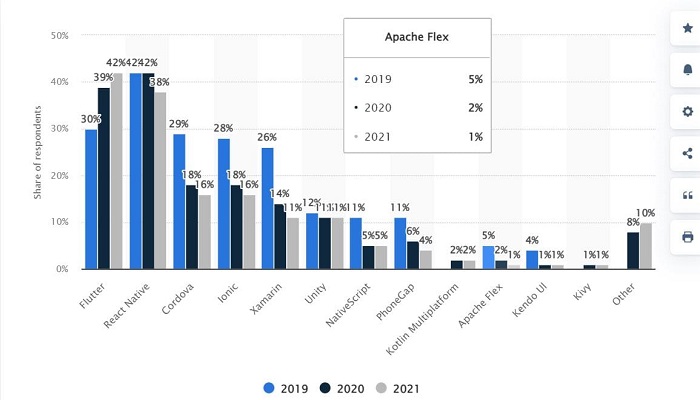
    Flutter is the most well-known cross-platform mobile framework that developers use. According to the 2021 survey, 42% of software developers use Flutter. Around one-third of mobile app developers use cross-platform technologies or frameworks, while others use native tools.

    Cross-platform mobile frameworks are used to develop an app that is accessible to a huge number of devices. A single code is used across multiple platforms for its easy portability, and in the end, it keeps the cost of software development low. With the cross-platform mobile framework, there is the possibility of maximum exploration of its targeted audience. For instance, an app can be targeted for both iOS and Android platforms, which will maximize the app’s reach. The global developer occupants is about to reach 28.7 million people by 2024, an increase of 3.2 million from the number viewed in 2020.

    What is Flutter?

    Flutter is the open-source UI toolkit created by Google and used to develop step-by-step mobile application development for mobile, web, and desktop with a single codebase.

    It was created to give tough competition to Facebook’s React Native. Still, Flutter has gained immense popularity in developing immersive apps for mobile and web apps and embedded and desktop apps.

    In Flutter, you can make beautiful, native cross-platform applications for iOS and Android platforms without worrying about any device. Flutter also gives a seamless experience across every viewing device.

    Flutter mobile apps are gaining an immense rise in the market because the apps built with Flutter capture the user’s attention with its properties like unified animation, faster time to market, affordability, and high performance. It becomes possible due to the Skia engine, Material Design, dart programming language, and Cupertino Widgets used by Flutter.

    What is Flutter App Development?

    Developing platform-independent apps that work on desktop, mobile, and web with the unified code and use Flutter as a UI toolkit is called Flutter app development.

    You can get a high-end, rich, and naturally immersive user experience for its clients via the Flutter app development. Single code means, Writing code once and running it everywhere. Hence, you can release the app across all the platforms in a single go. Hence, it saves time and money by rapidly launching your app in the market.

    Best frameworks for Mobile App Development

    What are the Characteristics of Flutter app development?

    Let’s see some of Flutter’s major characteristics and make it a good option for creating custom eCommerce websites.

    • It gives a rich selection of widgets that must use for almost every type of business.
    • It has a well-known mobile operating system, iOS and Android development, which is almost compatible with them.
    • As a hybrid platform, app development companies can reach a larger audience. It needs less development time and has a large and vibrant developer community.
    • It gives constant customization and maintenance of the app development.

    Why is Flutter well-known in Mobile App Development?

    Flutter shows a great rise in popularity among mobile app developers. Let’s see some of the features that make it unique in the mobile development industry and have raised the demand for the Flutter app development company.

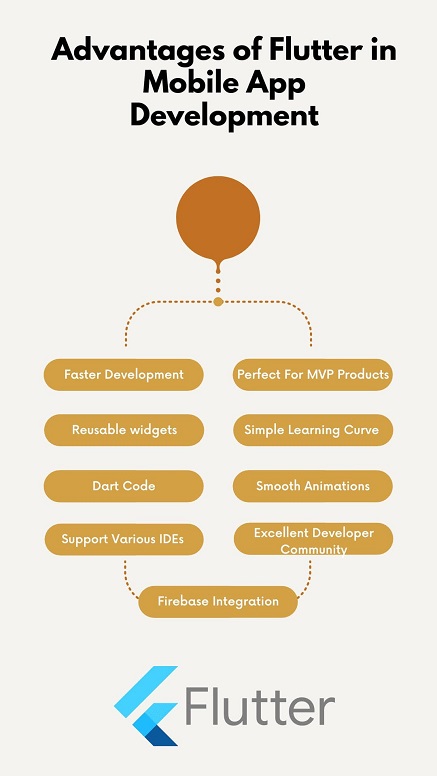
    1. Faster Development

    Flutter gives quick compilation and dynamic code writing, allowing you to see real-time changes. The Hot Reload feature will help you see the code’s live changes within seconds. Hence, developers can make them more productive by quickly making UI changes.

    2. Perfect for MVP products

    Flutter’s flexible UI, easy implantation, quick turnaround time, and high performance make it the best choice for MVP development. At an MVP stage, you usually need more time and money. It validates the app idea in the market or presents to the investors that there are better ideas than creating the app for the two platforms. Flutter uses a single codebase that helps you launch the apps that come across all platforms simultaneously, which aids you in saving time and money.

    3. Reusable widgets

    Flutter has come with an extensive set of customizable widgets catalog as these widgets are the structural elements wrapped with the material to design specific functionalities that can use for styling aspects like padding, setting fonts, etc. Hence, developers customize these ready-to-use widgets and compose their widgets in the multiple stages of the project.

    4. Simple learning curve

    Unlike other frameworks like React Native, Swift, and Java, Flutter is easy to learn. A UI open-source framework is much easier to learn and use if you have complete knowledge of the basics of Java and C#. Developers are looking to access source code that only needs to learn the basics of Dart.

    5. Dart codes

    Flutter uses object-oriented and strongly-typed dart code, which will act as the technical catalyst for the framework. Let’s see some of the few Dart’s fundamental aspects that make it requisite for Flutter development.

    • Just-in-time compilation
    • Eliminate the XML files
    • JavaScript bridge
    • Scaffolding
    Which are the Best Flutter Widgets for App Development in 2022?

    6. Smooth Animation

    Flutter gives a huge number of widgets that aid you in creating apps that follow a material design. The Material motion system for Flutter helps make the smooth transition between UI elements and helps to give a smooth and rich look. Flutter has in-built adjustments like GUI rendering, gestures, and animation, allowing a developer to control each pixelated element on display. Hence, it enhances the framework’s capability to make a smooth and rich app with a custom layout.

    Schedule an interview with WordPress developers

    7. Support various IDEs

    Flutter platform gives the most-effective support to the various IDEs to create apps that include IntelliJ Idea, Codemagic, Android Studio, etc. However, it also suggested using editor plugins (IDE) for a better user experience.

    8. Excellent Developer Community

    The Flutter framework is backed by millions of developers who actively participate in helping the community and framework grow by helping others give ongoing support and fix bugs.

    9. Firebase integration

    Firebase in the Flutter implementation is Google’s Backend-as-a-service (BaaS) platform for developing web and mobile applications. Experts can benefit from the firebase services like databases, analytics, crash reporting, and messaging. Hence, developers can take benefit of the firebase functionality of the Flutter framework by utilizing it.

    Top 10 Flutter app development tools

    Conclusion

    There are several reasons why experts believe that Flutter is undoubtedly the king of the mobile app development industry. The business benefits of Flutter are myriad. However, companies get their products to market quickly, reduce the cost, target multiple platforms and get the most clients at once.

    From a developer’s perspective, Flutter is easy to use and permits faster app development. Hence, the growing community ensures that any bugs and errors are promptly addressed!

    If you want to develop cross-platform apps using Flutter, hire Flutter developers from Bosc Tech Labs, as it assists you in development!

    Frequently Asked Questions (FAQs)

    1. Why is Flutter considered better than the other frameworks?

    The layered architecture grants developers control over every pixel and thus empowers them to make changes quickly and get into the intricate details of the design. Flutter does not rely on the native UI components to render. Hence, it uses an in-built Skia rendering engine and saves time.

    2. What makes the Flutter framework unique?

    Flutter is useful and can do the function using a single codebase. It means a coder can write the code once and run it everywhere in Flutter using the Dart UI coding language. As this code is natively compiled dependent on the platform/OS it is being run on.

    3. When should you make use of Flutter development?

    The applications developed in Flutter took little time to build and are also cost-effective. It is perfect for MVP startups when you are required to test your business model fast. Hence, Flutter app development costs less than native development for the two platforms.


    Book your appointment now

  • Dynamically Change The App Launcher Icon In Flutter

    Dynamically Change The App Launcher Icon In Flutter

    Flutter SDK is an open-source programming advancement pack for building attractive UI locally arranged. When we make a Shudder Venture, it accompanies the default Vacillate icon. The default icon can be changed to get the application distributed in stores like Google Play Store, Apple Application Store, and so on. In this article, we will investigate a couple of ways to accomplish something very similar.

    When fabricating a portable application in android or iOS stages, we need to change the default application name and launcher icon to a favored name and icon. This will be most helpful when sending an application to the play store or application store. This article will zero in on the most proficient method to change the application name and icon without any preparation in the Flutter structure.

    How to change the application launcher icon?

    It is essential to reference that while changing the application launcher icon better to pick a high-goal icon. You can create an Android application launcher icon through an Android icon generator or plan a launcher icon that suits your application utilizing another outsider application. Then, at that point, follow the underneath moves toward adding your launcher icon to your mobile application development.

    • Add the application launcher icon to the resources envelope of your undertaking and rename it as wanted.
    • Explore pubspec.YAML document, under dev_dependencies, adds the accompanying code snap. Click here to get more data on shudder launcher icons.
    • Save all changes that you make.
    • Go to the terminal, explore the shudder project area, and glue and run the accompanying orders.

    Why do we need to change the app launcher icon in Flutter?

    We want to compose the rationale for changing the application launcher icon in Flutter inside the press occasion [changeAppIcon] of the raised button gadget.

    With this, we finished the coding part for designing the dynamic application icons. After opening the venture in Xcode, add the application icon pictures inside the Sprinter/Sprinter envelope as displayed underneath. To get the component working, we want to add a few changes in info—the plist record, which is available inside the undertaker’s ios envelope.

    Add CFBundleAlternateIcons as a word reference inside the icon files (iOS 5) made previously. Make three-word references under CFBundleAlternateIcons, with the name like the icon pictures document name (for our situation, it is icon1, icon2 and icon3).

    For every word reference (icon1, icon2 and icon3), two properties — UIPrerenderedIcon and CFBundleIconFiles should be made. At long last, change the CFBundleIconFiles into an exhibit and add items with the worth as icon1, icon2 and icon3 for particular word references. Subsequently, we want to open the venture in XCode by right tapping on the iOS envelope.

    Specifying that and making a point to keep the dispersing correctly is critical. They take the complete solution and can develop it based on the Flutter development ideas. Changing the app launcher icon is the best way to explore Flutter for your desires.

    What are the two methods for changing the Application Icon?

    1. They are physically changing the documents of the Icon in Both Android and IOS envelopes by transferring every one of the expected icon sizes.

    2. We are utilizing a Bundle which will add every one of the extents of Icons in Android and IOS envelopes naturally.

    Move toward 1: Physically changing Icons

    Stage 1: Producing Different Estimated Icons

    • Go to https://appicon.co/and transfer the icon picture, tick the iPhone and Android choices, and tap on Produce. This site creates different estimated Icons for both android and IOS simultaneously.
    • It will Download the Compress document named AppIcons with the android and Assets. xcassets named envelopes alongside pictures for AppStore and playstore which can be straightforwardly transferred as an icon in both the stores.
    • Presently, open your Undertaking in Versus Code.

    Stage 2: Adding Icons in Android

    • Explore android/application/src/primary/res, right-click on res organizer, and snap “uncover in Pioneer”. Presently erase all the mipmap organizers in the res envelope and glue the mipmap organizers from the AppIcon/android envelope which you have downloaded.

    Stage 3: Adding Icons in IOS

    • Presently exploring the ios/Sprinter/Assets.xcassets. After you are in the Sprinter envelope, right-click on the Sprinter organizer and snap “uncover in Pilgrim”. Presently erase the Assets. xcassets envelope and glue the Assets. xcassets organizer from AppIcon/Assets.xcassets which you have downloaded.

    Stage 4: Run the Application

    • After physically changing the pictures in android and IOS envelopes, I currently go to lib/main.dart and run the vacillate project utilizing the underneath order in the Flutter console.

    Move toward 2: Utilizing Bundle ” Shudder Launcher Icons “

    We can create the different estimated Icons for Android and IOS by utilizing the bundle.

    Stage 1: Explore pubspec.YAML document.

    Open your Task in Versus Code and Go to pubspec.YAML document.

    Stage 2: Update the dev_dependencies.

    Go to dev_dependencies, add flutter_launcher_icons: “^0.8.0” reliance, and save the document. It will get the reliance.

    Stage 3: Add the reliance.

    Presently add the Flutter icons: and save.

    Stage 4: Add the Resources

    Presently make resources envelope – > make icon organizer – > add icon.png document.

    Stage 5: Download the conditions.

    Open the Terminal in VS Code and run

    Schedule an interview with WordPress developers

    Conclusion

    Thus, you can easily change the app launcher icon in Flutter depending on the requirements. They consider effective goals and maintain them by focusing on high-end documents.

    The icons should be turned out with a flexible change in the Flutter app development. The Flutter developers will know the best solution to change the app launcher icon in Flutter dynamically. Depending on the launch icon, it should be reliable to change in Flutter forever.

    So, it depends on the requirements and mentions by focusing on the download option. It makes an icon organizer with high-end results applicable for adding resources. It should be taken around the results and helpful for a reliable doc and save it. The above methods are useful for noticing it depends on the code and runs. It makes the icon organizer notice differently. It should be flexible based on the icon.png document option.

    Feel free to contact the leading Flutter app development company, which is ready to help you!

    Frequently Asked Questions (FAQs)

    1. What is the launcher icon in Flutter development?

    A Launcher icon is a graphic that will represent your app on the device’s home screen and also inside the launcher window. A user opens the launcher by simply touching the icon at the bottom of the Home screen. Hence, the launcher opens and exposes icons for all the installed applications.

    2. What makes an application dynamic?

    Dynamic applications are reliant on the online server or database. When connected, these apps are loaded from the central server so that any iterative changes to the development, design, or functionality are rolled out across all the devices simultaneously.

    3. Which widget type is utilized for the dynamic data in the Flutter framework?

    Flutter Dynamic Widget. A Backend-Driven UI toolkit creates the dynamic UI with JSON, and then the JSON format is very similar to the Flutter Widget Code.


    Book your appointment now

  • How to Validate Form With Flutter BLoC?

    How to Validate Form With Flutter BLoC?

    One of the integral parts of many applications is form validation. Mobile application developers always deal with the forms because it is essential to show relevant warnings to the users whenever they do not fill up the form correctly.

    Developers need to do this task appropriately, and for that, they need to write specific validation logic. Here, you will learn how to perform form validation with flutter Bloc. Are you facing any trouble while implementing this step and looking for an expert developer to perform the form validation process correctly in your business application? Then hire a Flutter developer from wpstag.bosctechlabs.net/ today..

    What does Flutter Bloc mean?

    Flutter Bloc is the state management in Flutter. You can access it to handle all the states you wish to perform in the flutter applications. It also acts as the best and simplest way to do state management. It allows you to effortlessly add any type of change to the flutter application.

    Regardless of your level, you can learn the concept quickly and add this dependency to your project. Google has created Bloc, which is nothing but the design pattern assisting to separate business logic from the aware layer. Additionally, it authorizes the developer to use the code efficiently.

    Flutter Bloc has several widgets such as Bloc Builder, Bloc Selector, Bloc provider, MultiBlocprovider, Bloc Listener, and Multi Bloc Listener. Every widget performs a specific action, and thus you have to use the right one suitable for your Flutter project.

    How to do form validation in Flutter

    The Flutter SDK renders the out-of-the-box widget and functionalities to make the user’s lives easier while accessing form validation. Two different approaches exist for form validation: the form widget and the provider package. Here are the steps to follow to start form validation in Flutter. Make sure you follow every step properly to get the desired output.

    • Create a form in Flutter; for instance, create a simple login page using the fields such as email, password, phone number, and name.
    • Set up the form to validate
    • Input validation and input formatters
    • Access Regex methods and Dart extension methods in the flutter project
    • You need to create the input fields required for the form.
    • Make the custom form field.
    • Perform form validation using provider, Bloc, or other techniques

    Here, you will know in-depth about the Bloc because it is the best way to validate the form. The bloc library renders the Flutter package for validating the fields. It is commonly called form_bloc.

    How to perform form validation using flutter Bloc

    As soon as you implement form validation using flutter BLoC, you need to add dependency in pubspec.ymal file to get all the properties of the Bloc. As a result, you can use it for state management efficiently.

    dependencies:
    flutter:
        sdk: Flutter
    cupertino_icons: ^1.0.2
    rxdart: ^0.27.3
    flutter_bloc: ^8.0.1

    Here, two dependencies rxdart and flutter_bloc are used. RxDart extends the capabilities of the Stream controllers and Dart Streams. Flutter_bloc is the use of Bloc Provider to render the Counter-cubit to the Counter-page and then react to the state changes with the BlocBuilder.

    Create the cubit class (login_bloc_cubit.dart) for the app that is an abstract class Cubit extends Bloc-base. Then, create the class by the name LoginScreenCubit(). After that, define the argument constructor and all the controllers you have used. Here is how it looks!

    LoginScreenCubit() : super(LoginInitial());
    //define controllers
    final _userNameController = BehaviorSubject();
    final _passwordController = BehaviorSubject();
    final _phonenoController = BehaviorSubject();

    You can obtain the data with the help of defined and stream controllers like below mentioned.

    Stream get userNameStream => _userNameController.stream;
    Stream get passwordStream => _passwordController.stream;
    Stream get phonenoStream => _phonenoController.stream;

    Now, it is time to create the method for clearing the data. For that, you can use the following code.

    void dispose() {
    updateUserName('');
    updatePassword('');
    updatePhoneNumber('');
    }

    Then, add the methods for validation. It is one of the vital steps in the entire project in which you can check the users’ value.

    //validation of UserName
    voidupdateUserName(String userName) {
      if (userName.length< 3) {
    _userNameController.sink.addError("Please enter at least 3 words");
      } else {
       
    _userNameController.sink.add(userName);
      }
    }
    //validation of Password
    void updatePassword(String password) {
      if (password.length< 4) {
    _passwordController.sink.addError("Please enter more then 4 words");
      } else {
    _passwordController.sink.add(password);
      }
    }
    //validation of Phone Number
    void updatePhoneNumber(String phoneNo) {
      if (phoneNo.length == 10) {
    _phonenoController.sink.add(phoneNo);
      } 
    else {
    _phonenoController.sink.addError("Please enter valid Phone Number");
      }
    }

    Then, create the provider class (bloc_provider.dart) that passes all the providers used in the Flutter application.

    ListblocProviders = [
    BlocProvider(create: (context) =>LoginPageCubit()),
    ];

    Next, you need to wrap MaterialApp() with MultiBlocProvider() that you define already in the bloc_provider.dart in main.

    MultiBlocProvider(
    providers: blocProviders,
      child: constMaterialApp(
    debugShowCheckedModeBanner: false,
    home: LoginScreen(),
      ),
    );

    Then, create the class with the name “login_bloc_state.dart in which you need to define LoginBloc{} and then LoginInitial that extends to LoginBloc{}.

    abstract class LoginBloc {}
    classLoginInitial extends LoginBloc {}

    Finally, in the LoginScreen(login_screen.dart), you must define LoginScreenCubit and add initiState(){}. In that, you can add WidgetsBinding.instance and access the dispose method properly.

    LoginScreenCubit? _loginScreenCubit;
    @override
    void initState() {
    WidgetsBinding.instance?.addPostFrameCallback((_) {
    _loginScreenCubit?.dispose();
      });
    super.initState();
    }

    Finally, you need to add BlocProvider in _loginScreenCubit. It helps you to get the right output of the login form with the values such as user name, password, and phone number.

    _loginScreenCubit = BlocProvider.of(
    context,
    listen: false,
    );

    Create UI and access StreamBuilder for the text field to update the data in the UI part properly. Here is the code to use.

    StreamBuilder(
    stream: _loginScreenCubit?.passwordStream,
    builder: (context, snapshot) {     
    returnTextField(
    onChanged: (text) {
    _loginScreenCubit?.updatePassword(text);   
    },
    decoration: constInputDecoration(
    labelText: 'Password',
    ),
              keyboardType: TextInputType.text);
        }),

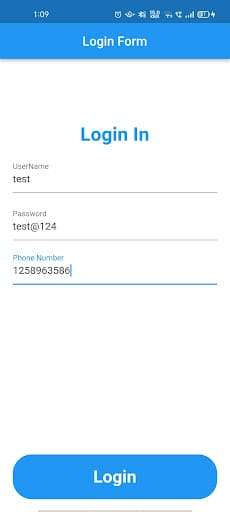
    When we run the application, we get the screen’s output like below.


    Created Form Output
    Created Form Output

    For Bottom Button we also use StreamBuilder. In this we pass _loginScreenCubit in the stream and cheBloc Widgetsck, whether the data is validated or not? after this we return GestureDetector() and apply a condition that if the data is updated then this screen goes to the next screen otherwise the login button is disable. When the snapshot. data is true then the color of the button will be teal otherwise it’s grey. Check out our guide to make floating action button in FLutter.

    _bottomButton() {
     return StreamBuilder(
       stream: _loginScreenCubit?.validateForm,
       builder: (context, snapshot) {
         return GestureDetector(
           onTap: () {
             if (snapshot.hasData) {
               Navigator.push(
                   context, MaterialPageRoute(builder: (context) => Home1()));
             }
           },
           child: Container(
             decoration: BoxDecoration(
                 color: snapshot.hasData ? Colors.teal : Colors.grey,
                 borderRadius: BorderRadius.circular(30)),
             height: 70,
             width: MediaQuery.of(context).size.width,
             child: const Center(
               child: Text(
                 'Login',
                 style: TextStyle(
                     color: Colors.white,
                     fontWeight: FontWeight.bold,
                     fontSize: 27),
               ),
             ),
           ),
         );
       },
     );
    }


    Final Form Validation Output
    Final Form Validation Output

    Schedule an interview with Flutter developers

    Conclusion

    This blog demonstrated how to perform form validation in Flutter with the help of Bloc. Besides, plenty of methods are there to do the same things. It would help if you used the right technique suitable for your Flutter project.


    Book your appointment now