• 9 Generative AI Development Companies in the USA

    9 Generative AI Development Companies in the USA

    Generative AI is not a buzzword anymore. It’s reshaping the way you work, create, and innovate. Wouldn’t you agree?

    From automating repetitive tasks and improving customer experiences to building smarter products, AI is helping businesses tap into possibilities that were hardly imaginable just a few years ago. With the rapid increase in AI usage, the number of companies in the USA specializing in generative AI solutions has skyrocketed, each offering unique ways to leverage the power of this technology.

    If you’re wondering which generative AI development company can turn your idea into reality, you’re in the right place. We have listed down 9 such organizations in the USA that can become your perfect development partner.

    Top 9 Generative AI Development Companies in the USA

    Company Name Established In Headquarters US Office Team Size Founded By
    BOSC Tech Labs 2019 Gandhinagar, Gujarat, India Burbank, California, USA 51-200 employees Mahesh Lalwani
    AccelOne 2013 Kirkland, Washington, USA Kirkland, Washington, USA 51-200 Scott Craig & Luis P.
    NineTwoThree AI Studio 2012 Danvers, Massachusetts, USA Danvers, Massachusetts, USA 51-200 Andrew Amann & Pavel Kirillov
    SynergyLabs 2016 Gurugram, Haryana, India Dover, Delaware 11-50 Sushil Kumar
    RTS Labs 2010 Glen Allen, Virginia Glen Allen, Virginia 51-200 Jyot Singh
    LeewayHertz 2007 Gurugram, Haryana, India San Francisco, California, USA 51-200 Akash Takyar & Deepak Shokeen
    Addepto 2018 Warsaw, Poland New York, USA 51-200 Artur  Haponik & Edwin Lisowski
    eSparkBiz 2010 Ahmedabad, Gujarat, India  Middletown, DE, USA 201-500 Harsh Kundariya & Harikrishna Kundariya
    SoluLab 2014 Los Angeles, California, USA Los Angeles, California, New York 201-500 Chintan Thakkar & Rajat Lala

    Let’s talk about these real changemakers, in detail, reshaping business landscapes through AI. Across the USA, several firms are helping businesses turn AI ideas into real, working products. Each brings its own expertise, tools, and creative approach to solving complex challenges.

    1. BOSC Tech Labs

    BOSC Tech Labs has been a part of these changemakers since 2019, delivering over 250 projects and maintaining about 95% client retention. Under the umbrella of generative AI development, BOSC Tech Labs specializes in transforming bold ideas into working realities across startups, SMB, and enterprise-level needs.

    Key Services

    • Generative AI Development
    • Mobile App Development
    • UI/UX Designing
    • WordPress Development
    • Web Development
    • Custom Software Development
    • Computer Vision Development

    Ratings

    5.0/5 based on 3+ Clutch reviews highlighting their quality and cost of deliverables.

    Headquarters

    They are based in Gandhinagar, Gujarat, India, and have a US office in Burbank, California.

    2. AccelOne

    When you plan to partner with AccelOne, you get a team deeply invested in transforming your vision into a secure, scalable, and future-ready AI product. Founded in 2013, AccelOne lets you tap skilled talent without sacrificing quality or communication.

    Key Services

    • Product Development
    • AI Development & Staff Training
    • Staff Augmentation
    • Custom Software Development
    • Mobile Development
    • Web Development

    Ratings

    4.9/5 based on 12+ Clutch reviews highlighting their responsiveness and integration capabilities.

    Headquarters

    AccelOne is headquartered in Kirkland, Washington, USA.

    3. NineTwoThree AI Studio

    When you work with NineTwoThree AI Studio, you get the expertise of developing 150+ products using a playbook forged for real-world successes. Since 2012, they have helped brands and funded startups turn AI, mobile, and web ideas into realities.

    Key Services

    • AI Consulting
    • Product Designing
    • UI/UX Designing

    Ratings

    4.9/5 based on 38+ Clutch reviews highlighting their timely and beyond-expectation deliveries.

    Headquarters

    It is headquartered in Danvers, Massachusetts, USA.

    4. SynergyLabs

    Synergy Labs is a team that thrives on innovation and precision. Since their inception in 2016, they have been at the forefront of application development with 250+ projects delivered.

    Key Services

    • SaaS Application Development
    • Mobile Application Development
    • API Development & Integration
    • Enterprise Solution

    Ratings

    4.7/5 based on 5+ Clutch reviews highlighting their overall proficiency in AI development.

    Headquarters

    It is headquartered in Gurugram, Haryana, India. However, they have a US office in Dover, Delaware.

    5. RTS Labs

    With RTS Labs, you are partnering with a team delivering impactful AI solutions for more than a decade now. Based in Virginia, RTS has successfully implemented 100+ AI-driven solutions across industries.

    Key Services

    • AI Development & Consulting
    • Data Science & Engineering
    • Custom Software Development

    Ratings

    3.7/5 ratings on Trustpilot based on reviews.

    Headquarters

    It is headquartered in Glen Allen, Virginia.

    6. LeewayHertz

    LeewayHertz is a seasoned AI development company that has been at the forefront of technological innovation since 2007. Based in Gurugram, India, LeewayHertz has successfully delivered 50+ AI solutions.

    Key Services

    • Generative AI Development & Customization
    • Data Engineering
    • Website Development
    • Customized Software Development
    • IoT

    Ratings

    4.7/5 based on 9+ Clutch reviews highlighting their innovative approach to AI development.

    Headquarters

    It is headquartered in Gurugram, Haryana, India.

    7. Addepto

    Addepto is a leading AI consulting company for delivering cutting-edge AI and data-driven solutions. Founded in 2018, Addepto, with 40+ AI experts, has finished 70+ projects.

    Key Services

    • AI Development & Consulting
    • Data Consulting & Engineering
    • LLMs Develpoment
    • Machine Learning Consulting

    Ratings

    4.9/5 based on 18+ Clutch reviews, suggesting their innovative and custom AI solutions.

    Headquarters

    It is headquartered in Warsaw, Poland. They also have an office in New York, USA.

    8. eSparkBiz

    eSparkBiz is an ISO 9001:2015-certified software development company founded in 2010. They have successfully delivered 1000+ projects.

    Key Services

    • Software Development
    • Application Development
    • AI Development
    • IoT
    • Software Testing

    Ratings

    4.9/5 based on 62+ Clutch reviews acknowledging their timely deliveries.

    Headquarters

    eSparkBiz is headquartered in Ahmedabad, Gujarat, India, with a US office in Middletown, DE, USA.

    9. SoluLab

    SoluLab is a leading AI software development company known for delivering innovative solutions that drive business transformation. They are entirely focusing now on leveraging the power of artificial intelligence to improve operational efficiency.

    Key Services

    • Blockchain Consulting
    • AI/ML Development
    • Software Development
    • IoT

    Ratings

    4.9/5 based on 46+ Clutch reviews showcasing their proficiency in working under challenging situations.

    Headquarters

    It is headquartered in Los Angeles, California, USA. They have other offices in New York and Ahmedabad, India.

    Choosing the Perfect AI Development Partner? BOSC Tech Labs Can Help

    Choosing the right AI development partner is key to turning your vision into impactful AI solutions. BOSC Tech Labs combines expertise, scalability, and a business-focused approach to help you achieve your AI goals.

    Contact BOSC Tech Lab team today to explore how we can accelerate your AI journey.

    Frequently Asked Questions

    1. What factors should I consider when selecting a Generative AI development company in the USA?

    Search for experience, technical expertise, and a team that understands your business goals. A development partner who aligns with your vision will make AI implementation much smoother.

    2. How much does Generative AI development cost?

    It depends on the complexity and the time required to develop your requirements. The average cost of an AI product can start around $5,000, with hourly rates ranging roughly from $25 to $150.

    3. How long does it take to deploy a custom AI solution for a business?

    Smaller projects usually take 2–3 months, while bigger enterprise solutions can take 4–5 months.

    4. Which industries benefit from Generative AI solutions?

    Almost every industry can benefit, from finance, healthcare, retail, manufacturing, marketing, to education, and beyond. AI helps automate, predict, and optimize business processes.

    5. Which company is leading in Generative AI development in the USA?

    Several companies stand out as reliable partners for your generative AI development, such as BOSC Tech Labs. They genuinely hold expertise across industries, and their business-focused approach turns your AI project into real-world solutions.
  • What Is Computer Vision? Techniques, Applications, and How It’s Changing the World

    What Is Computer Vision? Techniques, Applications, and How It’s Changing the World

    This blog will cover what computer vision is, the algorithms used, different sets of computer vision development techniques, and more.

    Computer vision is a process through which the computer processes and extracts visual data from images, videos, and more. In comparison to humans, computers have a harder time processing visual data. For the best in computer vision development services, visit www.seo.bosctechlabs.net.

    While it is easy for humans to perceive visual data by relying on memories and initial experiences, computers cannot. To perceive visual data, computers use artificial intelligence (AI), parallel computing, machine learning (ML), and deep learning (DL). These advanced technologies had limited capacity until AI blew up the market this year. 

    Not only did it work like an extension to humans but it managed to surpass them in tests related to scanning and labeling objects. 

    Last year, the global computer vision market size was valued at USD 20.31 billion in 2023 and has been forecasted to grow from USD 25.41 billion in 2024 to USD 175.72 billion by 2032.

    The Evolution of Computer Vision

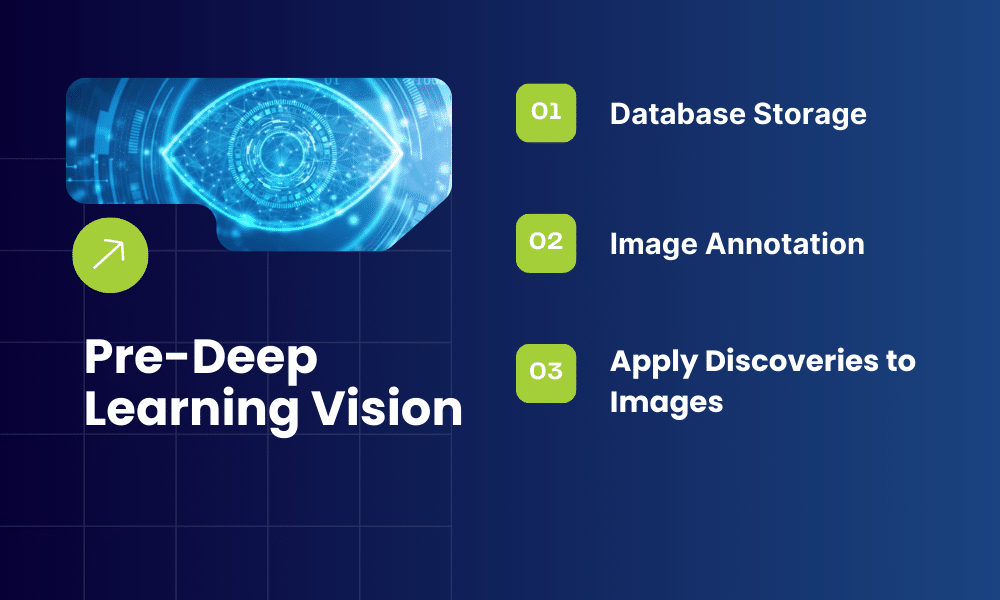
    Before deep learning, computer vision could perform tasks so limited that they needed lots of manpower. For example, if we wanted to conduct facial recognition then we needed to follow the following steps:

    Pre-Deep Learning Computer Vision

    Database Storage:

    Keep a database that would hold all the faces of the matters we are required to track.

    Image annotation:

    Save the features of images such as the distance between the nose and lips, eye length, length of the face, and more, which are distinctive for an individual.

    Apply discoveries to a new bunch of images:

    Repetition of picture annotation for a batch of new images and compare the distinctive markers.

    Not only does the ML allow us to recognize computer vision errors, but it is also able to address them. They’ve got programs called “features” that can process specific image designs. Creating or selecting a preconstructed algorithmic rule and preparing it with instances of the faces of humans it should identify is what is needed to craft a face recognition app operating with deep learning.In 2024, knowing about computer vision is vital. Partner with a top computer vision development company.

    How Computer Vision Works?

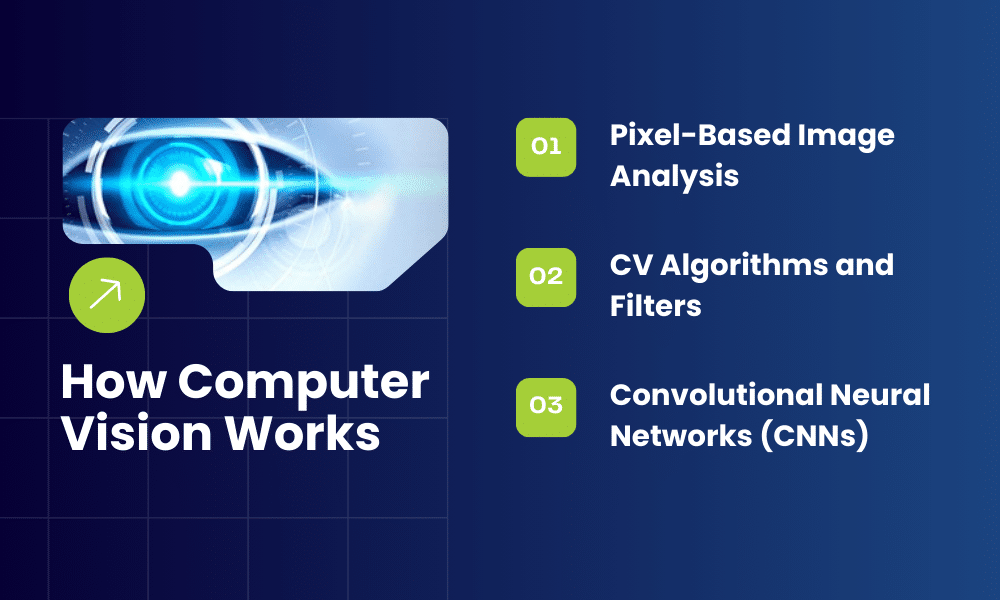
    As mentioned above, the way a computer perceives an image is different from that of humans. Instead of examining the whole image at once, the computer diverges it into pixels and utilizes the RGB values per pixel to apprehend if the picture includes important features.

    CV algorithms examine one pixel at a time and utilize a grain or filter that includes pixel multiplication codes for edge identification of objects. The computer can identify and distinguish the image by observing all aspects of it such as colors, shadows, and line drawings.

    Today, we utilize convolutional neural networks (CNNs) for modeling and conditioning. CNNs are fine neural networks, specifically created for pixel processing data and utilized for image recognition and processing. The convolutional layer comprehends neurons and tensors. The job of CNNs is to process extensive sets of information by comprehending to modifying their values to match elements that are important for determining different classes. This is done by broadly conditioning the model.

    What is Computer Vision used for?

    What is Computer Vision used for?

    Computer vision is one of the spaces in ML where core ideas are already being incorporated into a large number of products that we use in day-to-day life.  

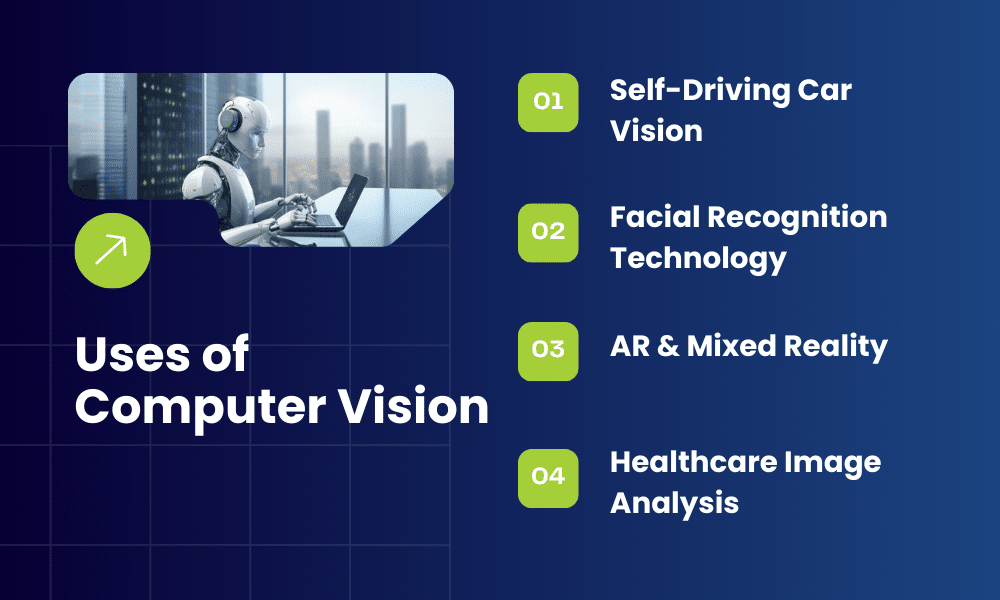
    Computer Vision in Self-driving Vehicles

    Tech companies aren’t the sole beneficiaries of machine learning for image applications. It has also taken self-driving cars by storm. 

    Computer vision helps self-driving cars get a clear picture of the surroundings. Computer vision is used in which video from different angles are fed to it, which processes the images in real-time to detect traffic signs, other cars, objects, and pedestrians on the road. With the assistance of computer vision, a self-driving car can now self-drive without hitting any objects and other vehicles. 

    Computer Vision In Facial Recognition

    CV is another key area in facial recognition applications, the technology allows the computer to align images of human faces to their identities. This technology is used in consumer devices, social media apps, and law enforcement to detect faces and match their identities.

    Computer Vision in AR & Mixed Reality

    Computer vision has a crucial role in augmented and mixed reality, it allows computing machines such as smartphones, smart glasses, and tablets to overlay and ingrain virtual objects into real-world imagery. CV’s algorithms enable AR apps to identify surfaces such as tabletops, walls, and floors, a crucial side of specifying depth and proportions and establishing virtual things in the real world. 

    Computer Vision In Healthcare

    Computer vision has advanced rapidly in the health-tech sector. Its programming can assist with automotive tasks such as identifying cancerous moles in the skin images or detecting symptoms in X-rays and MRI scans. 

    Types of Computer Vision Techniques

    Computer Vision Techniques

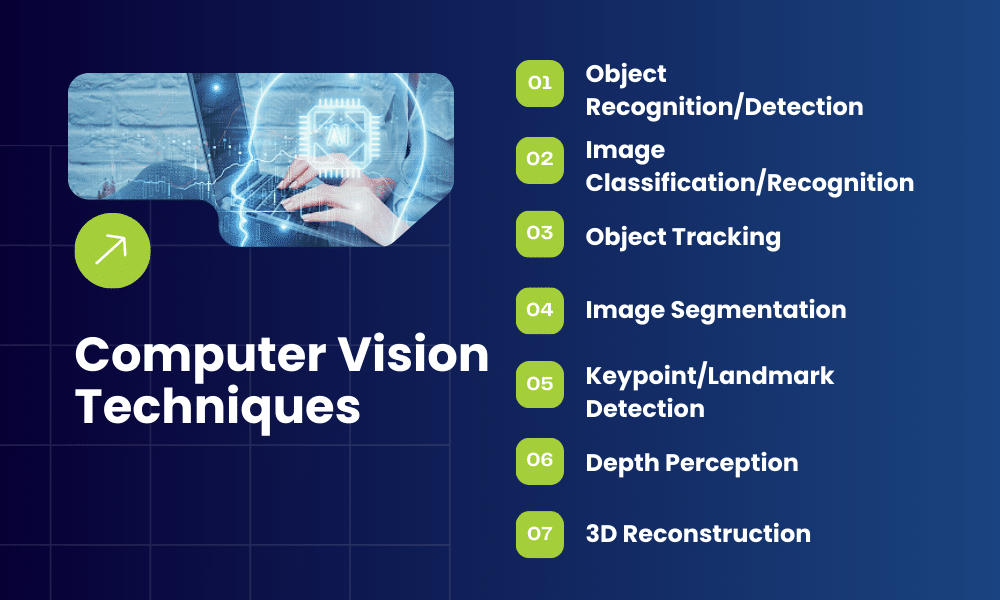
    Computer vision techniques are several methods and programs focused on extracting significant data from images and videos. Following are a few common types of computer vision techniques:

    1. Object Recognition/Detection

    We are now going to proceed and take image recognition one step ahead. Take an image with multiple objects in it, let’s say, a picture with a cat and a dog in it. With objects being separate from each other, object recognition will label each individual. 

    2. Image Classification/Recognition: 

    Image classification enables computer systems to accurately forecast the class of any given image. 

    Example: A picture of a dog will be classified by the computer as “girl”.

    3. Object Tracking:

    The task of object recognition is to identify objects in a single frame whereas, object tracking maintains the identity of objects in real-time as they move in a video. This allows computers to examine and comprehend the movement and demeanor of objects in live video streams.

    Also Read: Enterprise AI: Definition, Components, and Use Cases
    

    4. Image Segmentation:

    Image segmentation includes an image into several meaningful segments based on similar factors such as color or texture. Image segmentation is important in medical imaging for pinpointing and outlining several anatomical structures and oddities within the body in MRI or CT scans. 

    5. Keypoint/Landmark Detection: 

    As the name suggests, this technique includes identifying landmarks within a picture with visual significance. These specific key points function as a reference marker for devices to examine real-time content.

    6. Depth Perception:

    It allows computer systems to comprehend the depth or distance of the object from a reference point in the image. Depth perception allows these devices to perceive the objects in 3D representation by judging the relative distance of the objects. It is accomplished by blended abilities of depth sensors, stereo vision, and more. 

    7. 3D Reconstruction:

    The 3D representation is a model of an object from a 2D or a series of pictures. The 3D can be described as a digital model of the building crafted by an architectural company for renovation via drone images.

    [custom_cta title_cta=”Explore Computer Vision” text=” Explore The Full Guide To Master Computer Vision In 2024.” button_text=” Get Started Now!” button_url=”/contact/”]

    The Future that Computer Vision Will Lead

    Even though computer vision has progressed in today’s era, we still have a long way to go to reach its full potential. However, there are several healthcare institutions and firms that have sought ways to integrate computer vision systems, powered by CNNs, to real-time problems. Not only does it make everything practically easier, but it also makes everything much safer and more efficient. This trend of computer vision is likely to soar in the coming years, bringing new possibilities for change.

    Some common challenges in computer vision include:

    • Identifying what’s in a picture (image classification)
    • Finding specific objects in a picture (object detection)
    • Breaking down a picture into its different parts (image segmentation)

    Computer vision is used in many areas, such as:

    • Facial recognition technology
    • Analyzing medical images
    • Self-driving cars
    • Smart video analysis

    Today, computer vision systems can even outperform human vision!

    Begin Your Vision AI Journey with BOSC Tech Labs